
Introduction
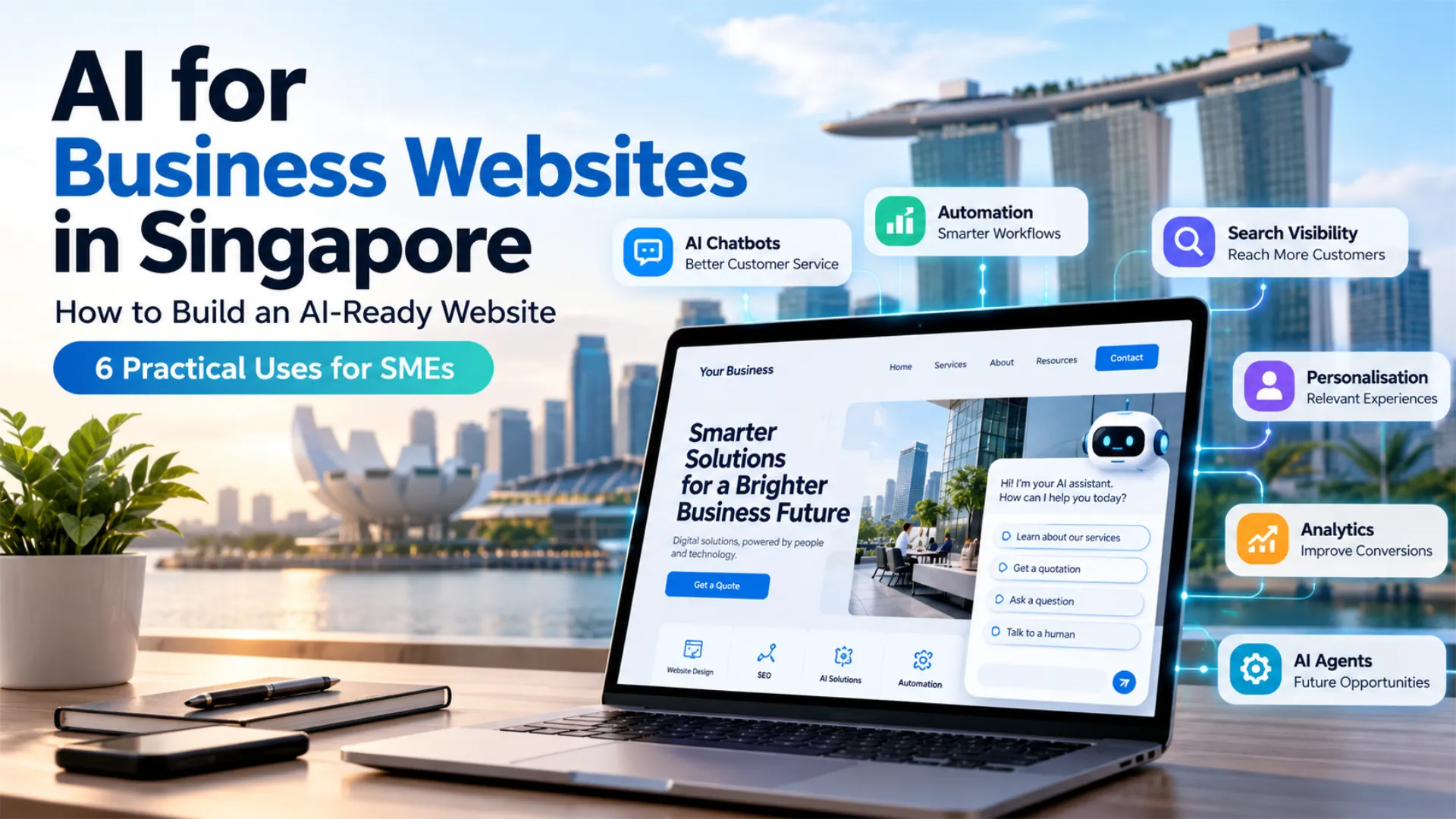
AI for business websites Singapore companies can use effectively is no longer limited to generating text or adding a basic chatbot. Artificial intelligence can now help businesses answer customer questions, organise enquiries, analyse website behaviour, personalise digital experiences and connect websites with wider business workflows.
For SMEs, however, the objective should not be to add as much AI as possible.
The better question is:
Where can AI make the website genuinely more useful for customers or more efficient for the business?
A successful AI-powered website Singapore business owners can rely on still needs the fundamentals of a good website: clear information, strong performance, mobile usability, security, search visibility and a well-designed customer journey.
AI should build on those foundations rather than compensate for a weak website.
As interest in AI solutions for SMEs Singapore continues to grow, businesses also need to distinguish between useful applications and technology that adds complexity without solving a meaningful problem.
If you are planning a new website or redesign, start with TechWeb’s Business Website Checklist Singapore to review the foundations before deciding which AI features are worth adding.
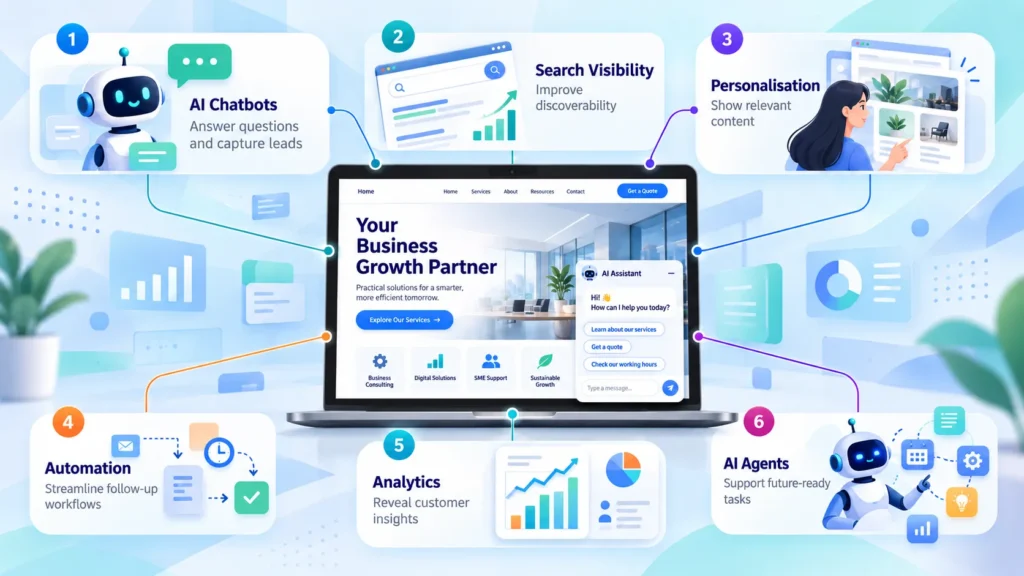
This guide examines six practical applications of AI for business websites Singapore, from AI chatbots and search visibility to automation, analytics and AI agents.
What Does an AI-Ready Website in Singapore Actually Need?
An AI-ready website is not simply a normal website with a chatbot added to it.
Good AI website development Singapore businesses can build on starts with a website that is structured, reliable and capable of connecting with other tools when necessary.
That means having:
- clear service and product information
- logical website architecture
- accurate and useful content
- reliable hosting
- appropriate security
- good mobile performance
- clear conversion paths
- maintainable technology
- the ability to integrate with suitable external systems
Consider an AI chatbot.
If the chatbot is expected to answer questions about a business’s services, it first needs reliable information to work from.
If it is expected to qualify enquiries, the business needs to decide what information should be collected, how the information will be used and what should happen after the enquiry is received.
The same applies to website AI integration Singapore projects involving CRM software, booking systems, calendars, email platforms or automation tools.
The underlying business process must make sense before AI is added to it.
This is why an AI-ready website Singapore business can develop over time begins with website strategy rather than software selection.
TechWeb’s SEO-Ready Website Development Singapore guide explains how site structure, content, search intent, performance and conversion planning can be considered from the beginning.
Once those foundations are in place, AI can make a business website considerably more useful.
1. AI Chatbot Singapore: Customer Support and Lead Capture
One of the most practical uses of AI for business websites Singapore SMEs can explore is conversational support.
Traditional chatbots usually followed fixed rules.
A visitor selected an option or entered a particular phrase and received a predetermined response.
Modern AI chatbots can interpret more natural questions and generate responses based on information made available to them.
What can an AI chatbot do?
An AI chatbot Singapore business may use could help:
- answer frequently asked questions
- explain products or services
- help visitors identify a suitable service
- provide basic business information
- collect contact details
- gather information about an enquiry
- support appointment or booking workflows
- direct complicated questions to a person
For example, a customer might ask:
“Do you build e-commerce websites?”
Another might ask:
“Can you create an online shop for around 100 products?”
A well-configured chatbot can recognise that both users are asking about the company’s e-commerce capabilities even though their wording is different.
Define the chatbot’s purpose
An AI chatbot should have a clear role.
Before implementation, decide whether its main purpose is to answer repetitive questions, capture leads after office hours, support existing customers or help visitors choose a service.
Businesses should also define where the chatbot’s role ends.
Some conversations need human involvement, particularly where the customer has a complaint, provides sensitive information or needs advice that requires professional judgement.
TechWeb’s AI Chatbot for Small Business Singapore guide explores chatbot implementation in greater detail.
For companies evaluating AI solutions for SMEs Singapore, conversational support can be a sensible place to start because the business problem is usually clear.
The goal is not necessarily to replace employees.
It is to let technology handle straightforward interactions while making it easier for staff to focus on customers who require experience, judgement or personal attention.
2. AI SEO Singapore: Search Visibility in an AI-Driven Search Environment
AI is also changing how people search for information.
Google Search now includes generative AI experiences such as AI Overviews and AI Mode.
This has led to increasing discussion around terms such as Answer Engine Optimisation, or AEO, and Generative Engine Optimisation, or GEO.
Businesses considering AI SEO Singapore strategies should not assume that these require an entirely new approach to search optimisation.
Google’s current guidance says the opposite.
Google states that its existing SEO best practices remain relevant to generative AI search because these experiences continue to rely on its core search ranking and quality systems.
Google also says businesses do not need special AI markup, special schema or new machine-readable files such as llms.txt to appear in its generative AI search features.
You can read Google’s current guidance in Optimizing your website for generative AI features on Google Search.
AI search visibility still depends on strong website foundations
For companies thinking about AI search visibility Singapore, the important question is whether search systems can access and understand the website.
Google continues to recommend practices such as:
- making important pages crawlable
- creating useful and original content
- maintaining a clear technical structure
- using relevant internal links
- providing a good page experience
- making important information available as text
- supporting content with useful images and video where appropriate
- keeping structured data consistent with visible page content
Google also explicitly warns against overproducing pages simply to capture every possible search phrase or AI query variation.
That matters for businesses pursuing AI website development Singapore.
There is no need to create hundreds of thin pages around slightly different keyword combinations simply because AI search exists.
Create content that answers real customer questions
Suppose someone searches:
“What should I check before choosing a website developer in Singapore?”
A web agency with detailed information about website ownership, SEO, maintenance, security, project scope and post-launch support gives search systems and potential customers much more useful material than a site containing only promotional slogans.
There is no guaranteed method for being included in a particular AI-generated answer.
Google itself notes that meeting its requirements and best practices does not guarantee that content will be crawled, indexed or served.
The sensible AI SEO Singapore strategy is therefore to concentrate on useful, authoritative content and technically sound SEO rather than promises of guaranteed AI citations.
TechWeb’s SEO-Ready Website Development Singapore guide covers these principles in more detail.
The goal remains straightforward:
Make it easy for people and search systems to understand what your business offers and why your information is useful.
3. AI Website Personalisation for More Relevant Customer Journeys
Visitors do not all arrive at a website with the same needs.
Someone discovering a company for the first time may want to understand its services.
A returning visitor may already be evaluating a particular solution.
Someone who has read several articles about SEO may be more interested in search optimisation than website development.
AI website personalisation can help businesses tailor parts of the digital experience based on relevant signals.
How can website personalisation work?
Depending on the platform and the information available, personalisation may involve:
- recommending related products
- suggesting relevant articles
- highlighting a service related to previous browsing behaviour
- changing recommendations according to customer interests
- helping users find suitable content more quickly
For an e-commerce site, personalisation might recommend related products.
For a service business, it might surface relevant case studies or guides.
For a content-rich website, it could help visitors discover related information.
Do not automate what good web design can solve
Many SMEs do not need sophisticated AI personalisation immediately.
Clear menus, sensible page structure, contextual internal links and well-designed calls to action can already provide an effective customer journey.
Someone reading about e-commerce development should naturally be able to reach the relevant e-commerce service page.
AI is not required to make that happen.
An AI-powered website Singapore business uses successfully should therefore apply personalisation only where it adds meaningful value.
A useful principle is:
Do not use AI to solve a problem that good website design can solve more simply.
4. AI Website Automation for Enquiries and Lead Management
One of the most commercially useful areas of AI may be AI website automation.
Many business websites still handle enquiries through a largely manual process.
A customer completes a form.
An email arrives.
An employee reads it.
Someone decides what the enquiry concerns.
The information may then be copied into another system before follow-up begins.
This process works, but it can create delays and repetitive administrative work.
From form submission to structured workflow
Imagine a customer tells a web agency:
We need an e-commerce website with around 200 products and hope to launch within four months.
A conventional contact form simply sends that message to an inbox.
With carefully designed AI automation for SMEs, a workflow could potentially help classify the enquiry, identify the requested service, extract useful project information and route it to the appropriate person.
AI could also summarise a longer enquiry before it reaches the employee responsible for follow-up.
The important distinction is that the AI system does not need to make the commercial decision.
It can reduce repetitive work before a person makes the decision.
Connecting websites to business systems
AI website automation becomes more useful when the website can appropriately connect with systems such as:
- CRM platforms
- calendars
- email systems
- customer service platforms
- project management software
- sales workflows
- internal databases
A workflow might look like this:
Website enquiry → information captured → enquiry classified → relevant team notified → human follow-up
For businesses considering website AI integration Singapore, this may create more practical value than adding highly visible AI features simply for appearance.
The website becomes part of the company’s operating workflow rather than only an online brochure.
5. AI Analytics for Websites and Conversion Optimisation
Website analytics traditionally helps businesses understand what has already happened.
How many people visited?
Which pages attracted traffic?
Where did visitors leave?
Which channels generated enquiries?
AI analytics for websites can make it easier to explore this information and identify patterns.
Ask better questions of website data
AI-assisted analytics tools may make it easier for users to investigate questions such as:
- Which pages are frequently visited before an enquiry?
- Which landing pages receive traffic but relatively few conversions?
- Where are mobile visitors leaving the site?
- Which articles lead visitors towards service pages?
- Which customer journeys are associated with stronger conversion rates?
This can make website data easier to explore for business owners who are not analytics specialists.
However, AI does not eliminate the need for good measurement.
Define what success means first
A business needs to decide what a website conversion actually is.
For an e-commerce store, it may be a completed purchase.
For a consultancy, it may be a consultation booking.
For a professional services company, it could be a qualified enquiry.
For another business, a phone call or WhatsApp conversation may be more valuable.
This is why AI solutions for SMEs Singapore should be tied to clearly defined business outcomes.
If an AI chatbot is intended to improve lead generation, measure lead quality.
If AI website automation is meant to reduce administration, measure whether it actually saves staff time.
If AI-assisted analytics is meant to improve conversions, track whether conversion performance improves.
The technology should support an outcome that matters.
6. AI Agents for Business Websites
AI agents represent a more advanced stage of website automation.
A chatbot mainly provides information.
An agent can potentially perform a sequence of actions to achieve a defined objective.
For example, a website-based agent might eventually help a customer identify an appropriate appointment, check available time slots and complete a booking after the customer confirms.
This is more powerful than simply answering a question.
It also introduces additional risks.
Singapore’s guidance on agentic AI
Singapore’s Infocomm Media Development Authority launched its Model AI Governance Framework for Agentic AI in January 2026 and updated it in May 2026 with additional case studies and emerging practices.
The framework recommends that organisations consider issues including:
- limiting the autonomy and access given to agents
- identifying points where human approval is required
- implementing technical controls throughout the agent lifecycle
- maintaining meaningful human accountability
- being transparent with users
This matters because AI agents for business can potentially interact with systems and data rather than simply generate text.
There is a substantial difference between allowing an AI assistant to explain information already published on a website and allowing an agent to alter customer records, modify an order or initiate a transaction.
The greater the potential impact, the stronger the controls should be.
For most SMEs, autonomous AI agents do not need to be the first stage of adoption.
A stronger starting point is an AI-ready website Singapore business can connect to deeper automation later when there is a clear operational need.
Building an AI-Powered Website Singapore Businesses Can Grow With
Before investing heavily in AI, examine the website underneath it.
A sustainable AI-powered website Singapore business can improve over time should have a strong technical, content and customer-experience foundation.
Important products and services should be clearly explained.
Business information should remain accurate.
Pages should work reliably on mobile devices.
The site should load well and search engines should be able to access important content.
Visitors should also understand what to do next.
Should they request a quotation?
Book an appointment?
Make a purchase?
Call?
Start a chat?
Clear conversion paths still matter regardless of how much AI is involved.
Website maintenance remains important
Artificial intelligence does not eliminate the need for ongoing website maintenance.
Software still needs updates.
Forms need testing.
Backups need checking.
Links can break.
Business information changes.
Security risks evolve.
TechWeb’s Website Maintenance Singapore service covers updates, backups, security checks, bug fixes, technical support and ongoing website care.
An AI-ready website Singapore business owners can rely on should also be flexible enough to accommodate future integrations without requiring a complete rebuild whenever technology changes.
PDPA, Personal Data and AI Websites in Singapore
Businesses need to think carefully about data protection when AI features collect, use or disclose personal data.
Singapore’s Personal Data Protection Act provides the baseline framework governing personal data handled by organisations.
The PDPC’s Data Protection Obligations include requirements relating to areas such as notification, consent, purpose limitation, protection, retention and overseas transfers, subject to applicable exceptions.
These obligations are relevant whether the technology involved is described as AI or not.
AI-specific PDPC guidance has a narrower scope
The PDPC also published its Advisory Guidelines on the Use of Personal Data in AI Recommendation and Decision Systems in March 2024.
Those guidelines provide guidance on areas including the development and deployment of AI systems that make recommendations, predictions or decisions, consent information and the role of third-party developers that may act as data intermediaries.
They should not be interpreted as a blanket set of chatbot rules covering every possible AI website feature.
For businesses implementing AI solutions for SMEs Singapore, the practical questions include:
- What personal data does the system collect?
- Why is the information needed?
- How will it be used?
- Which third parties receive or process it?
- Is information transferred outside Singapore?
- How long is it retained?
- What safeguards protect it?
These questions are especially important when customers can type free-form information into an AI chatbot because users may provide information that the business did not anticipate collecting.
Responsible AI for business websites Singapore implementation therefore requires attention to both technology and data governance.
EDGE Grant and AI Digital Transformation in Singapore
Singapore’s business grant structure changed on 30 September 2026.
Enterprise Singapore states that the former EDG, MRA and PSG schemes ceased accepting new applications after 29 September 2026. New applications for business grant support now fall under the EDGE Grant.
EDGE covers multiple business areas, including Automation & Digitalisation.
However, it is important not to assume that every website, chatbot or AI software purchase qualifies.
Support varies according to the specific activity.
For example, Enterprise Singapore’s current Large-scale Digital Transformation activity lists up to 50% support for SMEs and up to 30% for non-SMEs.
It also requires more than a simple software installation.
Among other conditions, eligible projects must demonstrate measurable impact on growth and efficiency, strengthen core operations using technologies such as cloud platforms, data analytics, AI or machine learning, RPA or workflow automation and involve integration or standardisation across business systems.
The page also specifically lists isolated automation and basic IT upgrades among examples of costs or activities that are not supported under that activity.
This distinction is important for AI business automation Singapore projects.
A business should not adopt an AI tool simply because it hopes a grant will pay for it.
Start with the business case.
Then determine whether the proposed project fits the current EDGE activity requirements before making commitments or payments.
Where Should SMEs Start With AI Website Development Singapore?
For businesses exploring AI website development Singapore, the first question should not be:
Which AI platform should we buy?
Start with the problem.
Perhaps enquiries arrive after office hours.
Perhaps staff repeatedly answer the same questions.
Perhaps website leads contain too little information.
Perhaps potential customers struggle to identify the right service.
Perhaps employees manually move website information into other systems.
Perhaps the website contains useful expertise but receives limited search visibility.
These are business problems.
Once the problem is clear, decide whether AI is actually the best solution.
Sometimes it will be.
Sometimes clearer content, better navigation, stronger SEO or a better enquiry form will solve the problem more effectively.
The goal of AI solutions for SMEs Singapore should not be to maximise AI adoption.
It should be to improve customer experience, business efficiency or both.
A Practical AI-Ready Website Roadmap
Businesses considering AI for business websites Singapore can take a progressive approach.
Step 1: Strengthen the website foundation
Make sure the website is secure, mobile-friendly, fast enough for its users and easy to navigate.
Step 2: Improve the content
Clearly explain important services and products.
Answer genuine customer questions.
Make useful information easy to find.
Step 3: Identify repetitive processes
Review customer enquiries, lead qualification, appointment requests and administrative follow-up.
These areas may reveal opportunities for AI automation for SMEs.
Step 4: Choose the AI use case
A chatbot may be appropriate for one company.
AI website automation may create more value for another.
A business with substantial website traffic may benefit more from AI analytics for websites.
Step 5: Plan integrations carefully
Design website AI integration Singapore around actual workflows rather than connecting systems simply because integration is technically possible.
Step 6: Define safeguards
Determine which actions AI may perform independently and which require human review.
Consider personal data, system access and the consequences of incorrect actions.
Step 7: Measure the outcome
If the chatbot is supposed to improve enquiries, assess lead quality.
If automation is supposed to reduce administration, measure time saved.
If analytics is supposed to improve conversion, track the relevant conversion metric.
AI should demonstrate useful business value.
Frequently Asked Questions About AI for Business Websites Singapore
What is an AI-ready website?
An AI-ready website is a technically sound, well-structured website that can support suitable AI tools and integrations.
It still needs the fundamentals of good website development, including useful content, security, good performance and clear customer journeys.
What does AI website development Singapore involve?
AI website development Singapore can involve building or improving websites so that they can support capabilities such as chatbots, automation, analytics, personalisation or integrations with other business systems.
The right features depend on the business requirements.
Does every SME website need AI?
No.
AI should be used when it solves a meaningful problem.
A company may gain more value from improving its website structure, content, search visibility or enquiry process before adopting AI.
What are practical AI solutions for SMEs Singapore?
Depending on the business, practical applications may include AI-assisted customer support, lead qualification, workflow automation, analytics, content assistance and selected integrations with business systems.
What is AI website automation?
AI website automation involves using AI as part of a workflow triggered by website activity.
For example, AI may help summarise an enquiry, classify its subject or route it to the appropriate team.
A human can remain responsible for decisions that require judgement.
Does AI replace SEO?
No.
Google’s 2026 guidance explicitly states that conventional SEO best practices remain foundational to its generative AI search features.
Good technical SEO, useful content, crawlability, internal links and user experience remain important.
Do businesses need GEO for AI search visibility?
GEO and AEO are widely used industry terms, but Google says there are no special technical requirements for its generative AI search features.
Google specifically advises site owners to prioritise SEO fundamentals and useful content rather than supposed AI-search hacks.
Can an AI chatbot replace customer service staff?
AI chatbots can handle some routine enquiries, but they are not suitable for every conversation.
Businesses should provide a route to human assistance where an enquiry is complicated, sensitive or requires professional judgement.
What are AI agents for business?
AI agents are systems capable of planning or taking actions towards defined objectives rather than simply generating responses.
Because agents may be able to interact with tools, systems or data, organisations need to consider permissions, safeguards and human oversight.
Does the PDPA apply to AI website features?
The PDPA applies where an organisation collects, uses or discloses personal data, subject to the Act’s requirements and exceptions.
Businesses should assess their actual data flows rather than assuming that using a third-party AI provider transfers responsibility away from them.
Can an AI website project receive an EDGE Grant?
Possibly, but eligibility depends on the specific EDGE activity and project.
A standalone chatbot, ordinary website redesign or isolated software installation should not be assumed to qualify.
Businesses should review the current Enterprise Singapore criteria before starting work or making payments if grant support is important to the project.
Build the Website Foundation Before Adding AI
The potential of AI for business websites Singapore is significant, but successful adoption is not about putting AI everywhere.
AI chatbots can support customer enquiries.
AI SEO Singapore strategies can help businesses adapt to changing search experiences while retaining sound SEO fundamentals.
Personalisation can make some customer journeys more relevant.
AI website automation can reduce repetitive work.
AI analytics can help businesses explore website data.
AI agents may increasingly allow websites to interact with other business systems.
But all six applications depend on a strong digital foundation.
For companies considering AI website development Singapore, the priorities remain clear messaging, useful content, logical structure, good search visibility, reliable technology, security and a customer journey that makes sense.
An AI-ready website Singapore business can grow with should be designed to accommodate useful technology as requirements evolve, rather than being overloaded with AI features from the beginning.
The strongest AI solutions for SMEs Singapore combine good website development, SEO, sensible automation and responsible AI implementation.
TechWeb helps Singapore businesses build structured, SEO-ready websites designed for performance, adaptability and long-term growth.
If you are planning a new website or want to prepare your current site for practical AI integrations, start a website project with TechWeb.




2 thoughts on “AI for Business Websites in Singapore: How to Build an AI-Ready Website”
Pingback: AI Chatbots for Small Business in Singapore: What You Need to Know - TechWeb
Pingback: AI Chatbot Singapore: 7 Practical Ways SMEs Can Use AI