Introduction
Imagine a potential customer looking for a service your business provides.
A few years ago, they might have searched Google, opened several websites and compared the options themselves.
Today, that same customer might ask ChatGPT to recommend a suitable provider, use Google’s AI-powered search features to compare services or turn to Microsoft Copilot for an explanation before making a decision.
The customer still needs a trustworthy business. What has changed is how they discover one.
For businesses in Singapore, this creates a new challenge. A professional website and traditional search engine optimisation (SEO) remain important, but they may no longer be enough to capture every opportunity for online discovery.
This is where AI SEO Singapore becomes relevant.
AI SEO is not about replacing conventional SEO with a new collection of tricks. It is about making your business easier to discover, understand and evaluate across traditional search engines and AI-powered search experiences.
The important question is no longer simply whether your website appears in Google. It is whether potential customers can find useful, accurate information about your business wherever they begin their search.
What Is AI SEO?
AI SEO refers to optimising a website and its online presence for visibility across both conventional search engines and AI-powered discovery tools.
Traditional SEO primarily focuses on helping relevant pages appear in search results when users enter specific queries.
AI-powered search adds another dimension. Instead of displaying only a list of websites, systems may generate explanations, compare options and recommend sources that help answer a user’s question.
For example, consider these two searches:
Traditional search: “Marine spare parts supplier Singapore”
Conversational AI search: “Which suppliers in Singapore can help vessel operators source marine spare parts quickly, and what should I check before choosing one?”
The second question requires a broader response. A useful answer may draw on information about suppliers, services, product availability, delivery arrangements and industry experience.
A supplier whose website clearly explains these details has made it easier for customers to evaluate its suitability. That is valuable regardless of whether the customer arrives through Google, ChatGPT or another platform.
AI SEO, AEO and GEO: Are They Different?
Businesses researching AI search may encounter several terms:
- SEO (Search Engine Optimisation): Improving a website’s visibility in traditional organic search results.
- AEO (Answer Engine Optimisation): Structuring information to help answer users’ questions clearly.
- GEO (Generative Engine Optimisation): A term used for improving visibility in generative AI search experiences.
These terms describe overlapping approaches rather than completely separate disciplines.
Google’s own guidance on generative AI search confirms that established SEO practices remain foundational to visibility in its AI-powered features.
The practical implication is straightforward: businesses should strengthen the quality, accessibility and usefulness of their websites before investing in specialised AI search tactics.
How Do Google, ChatGPT and Microsoft Copilot Find Businesses?
Not every AI search platform works in the same way.
Understanding the differences helps businesses avoid paying for optimisation techniques that may have little practical value.
Google Search and AI Overviews
Google uses its search index and ranking systems to identify relevant information that may support AI-generated answers.
To be eligible to appear as a supporting link in Google’s AI features, a page generally needs to be indexed and eligible to appear in Google Search with a snippet. Google’s current guidance also covers website participation in generative AI features.
There is no special AI schema or separate AI-only content format required.
Businesses can read TechWeb’s detailed Google AI Overviews SEO guide for a closer look at these features.
ChatGPT Search
ChatGPT can use web search to find current information and provide links to supporting sources.
For website owners, one important technical consideration is whether the site permits OpenAI’s search crawler, OAI-SearchBot, to access publicly available content.
OpenAI distinguishes this crawler from GPTBot, which is associated with crawling for model training. Allowing search access does not require granting every type of crawler the same permissions.
However, permitting access does not guarantee that ChatGPT will reference or recommend a business.
What matters is making useful, accurate information available so that it can be discovered when relevant.
Microsoft Copilot and Bing
Microsoft also uses web information to support AI-generated search experiences.
Bing Webmaster Tools includes an AI Performance report that can show when eligible website content is cited in supported AI experiences, including Microsoft Copilot.
This provides another way to understand whether your content is being referenced, although citation counts do not automatically translate into website visits or enquiries.
For Singapore businesses, the lesson is not to optimise separately for every AI platform. It is to build a reliable online presence that search and discovery systems can access and understand.
Why Some Singapore Businesses May Be Difficult to Discover in AI Search
Consider a small engineering company with an attractive website.
Its homepage features a modern design, professional photographs and a headline that reads:
“Innovative Solutions for a Better Tomorrow.”
It sounds impressive, but what does the company actually do?
Does it provide precision engineering, machinery maintenance, fabrication or industrial automation? Which industries does it serve? Does it operate throughout Singapore? What distinguishes its services?
If visitors cannot easily find these answers, the website is not doing its job.
This becomes especially important when AI-powered systems retrieve information to answer detailed questions.
A clearer homepage might say:
“Precision Engineering and CNC Machining Services in Singapore”
The page could then explain the types of components produced, materials supported, industries served and how prospective customers can request a quotation.
The second version is not necessarily more sophisticated. It is simply more useful.
Effective AI SEO begins with making the business understandable, not with adding more keywords.
Start With What Customers Are Actually Searching For
One of the biggest mistakes in SEO is focusing on phrases that sound technically impressive without establishing whether potential customers use them.
A Singapore business does not need to rank for every emerging AI-related term.
It needs visibility for the searches that are relevant to its products, services and customers.
These searches generally fall into three categories.
| Search type | Example | Business opportunity |
|---|---|---|
| Service search | “Website design company Singapore” | Customer looking for a provider |
| Comparison search | “WordPress vs Shopify for Singapore business” | Customer evaluating options |
| Problem-solving search | “Why is my business website not appearing on Google?” | Customer looking for a solution |
These are examples of search intent, not claims about verified keyword search volumes.
Each category deserves a different response.
A service search should lead to a clear service page. A comparison search may be better served by a detailed guide. A problem-solving query should provide useful explanations and practical next steps.
The objective is to build a website that answers genuine customer needs instead of publishing multiple articles targeting slightly different versions of the same keyword.
This is particularly important for smaller Singapore businesses with limited marketing budgets.
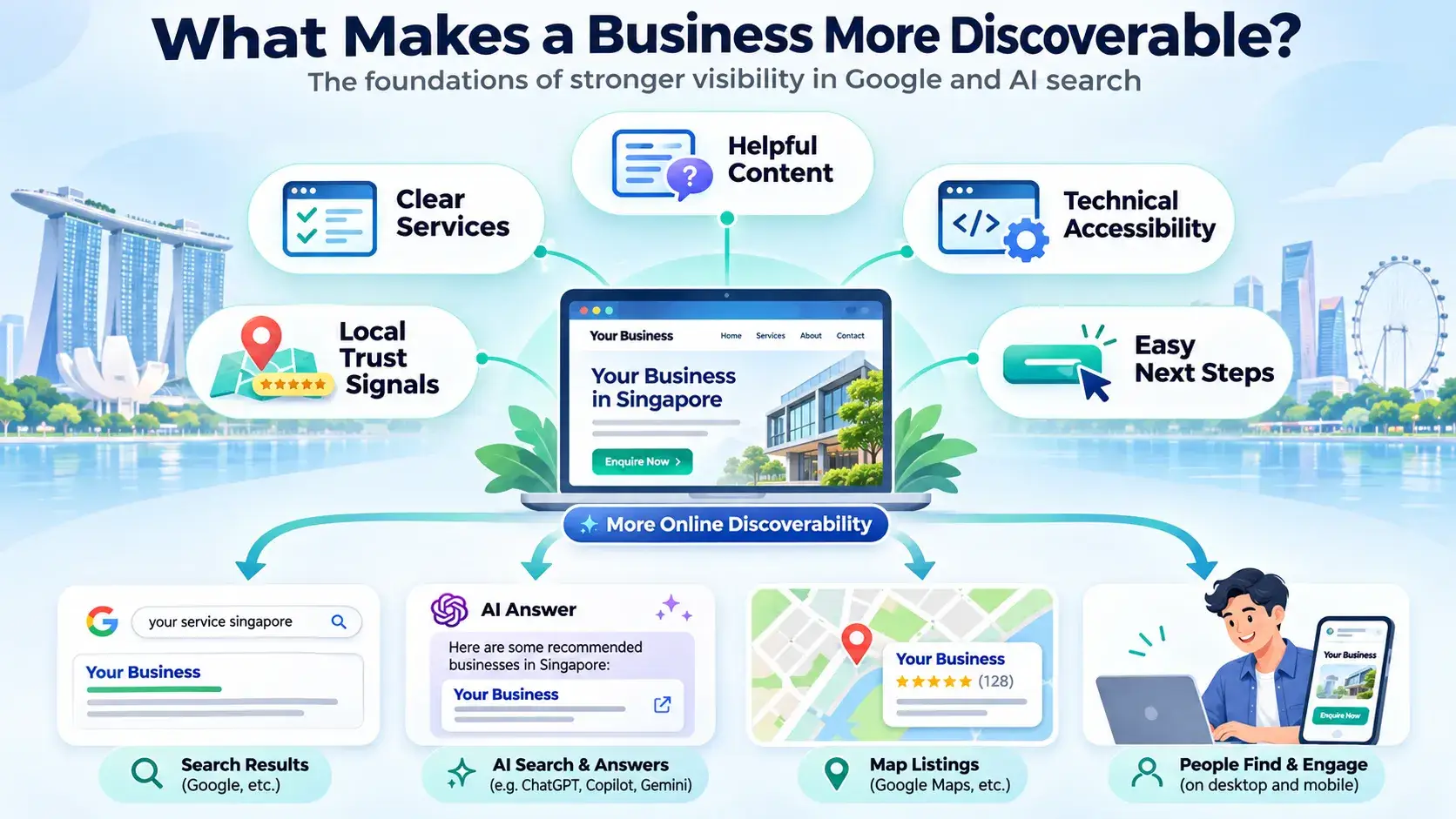
What Makes a Business More Discoverable in AI Search?
There is no guaranteed formula for appearing in an AI-generated recommendation. However, businesses can improve the quality of their online presence by focusing on several practical areas.
1. Make Your Services Clear and Specific
Your website should explain exactly what your business offers.
Avoid relying on vague expressions such as “complete solutions”, “trusted partner” or “leading expertise” without supporting information.
For every important service, answer four questions:
- What service do you provide?
- Who is the service intended for?
- What problem does it solve?
- How can customers take the next step?
For example, a business offering commercial air-conditioning services could explain its maintenance packages, types of properties served, inspection procedures and service coverage.
This information is helpful to human visitors and makes the page’s purpose clearer to search systems.
2. Demonstrate Experience Instead of Making Generic Claims
Many websites describe themselves as experienced, professional and reliable.
Far fewer explain what those qualities mean in practice.
A stronger approach is to publish evidence that helps customers make informed decisions.
An interior design company might explain how it manages renovation budgets, compares material options or handles common space-planning constraints in Singapore apartments.
A logistics provider could outline its operational capabilities, delivery arrangements and documentation procedures.
A web development agency might explain why a technically functional website can still struggle to attract enquiries.
Original examples, project details, useful explanations and accurate business information are more valuable than repeating generic advice.
Where possible, support claims with photographs, genuine customer feedback, portfolio examples and verifiable information.
3. Build Service Pages Around Customer Decisions
A blog can attract visitors researching a subject, but it should not replace clear service pages.
Suppose a business wants to attract customers searching for website development in Singapore.
Its website should have a dedicated service page explaining the offering, the types of websites available, the development process and how to request a quotation.
Supporting articles can address questions about website costs, choosing a content management system or improving search visibility.
This creates a logical path from research to enquiry.
For example, someone reading an article about website performance should be able to find relevant SEO services in Singapore without having to search the website again.
The goal is not simply to attract traffic. It is to help qualified visitors take an appropriate next step.
4. Keep Your Website Technically Accessible
Even excellent content may struggle if search engines cannot access or index the pages.
A sound technical foundation includes:
- Important pages that are accessible and eligible for indexing
- Correct robots.txt and indexing settings
- A logical internal linking structure
- Mobile-friendly pages with good usability
- Descriptive page titles and clear headings
- Useful content available in readable text
- Relevant structured data that accurately reflects visible content
Businesses should also verify whether their security systems or hosting configurations unintentionally block legitimate search crawlers.
An XML sitemap can help search engines discover URLs, but submitting one does not guarantee indexing.
Similarly, adding special AI-related files or excessive schema markup is not a shortcut to AI visibility.
Technical SEO should make information accessible and understandable, not create artificial complexity.
5. Strengthen Your Singapore Business Presence
Local relevance matters when customers need a provider operating in a particular market.
A business serving Singapore customers should make its service coverage and business details clear.
Where eligible and appropriate, maintain an accurate Google Business Profile. Ensure your business name, contact information, operating details and services are consistent with your website.
Customer reviews, legitimate industry listings and relevant mentions from other websites may also help prospective customers assess your credibility.
For businesses operating in specialised industries, useful local content can make a difference.
A marine services provider, for example, could explain the types of vessels it supports, its service arrangements in Singapore and relevant operational capabilities.
This gives customers more useful information than a generic company description.
Localisation should reflect genuine business expertise, not simply inserting the word “Singapore” into every paragraph.
How Can Businesses Measure AI SEO Results?
AI search visibility should be measured carefully.
Being mentioned in an AI-generated answer is not the same as receiving a website visit. Likewise, increased website traffic does not automatically mean more sales.
A practical measurement approach combines traditional SEO reporting, available AI search data and actual business outcomes.
Google Search Console
Google Search Console helps businesses monitor how their websites perform in search.
In 2026, Google introduced a dedicated Generative AI performance report covering impressions in AI Overviews and AI Mode.
Businesses can use this report to review which pages receive impressions and how visibility varies by date, country and device.
The report does not provide every conversational prompt or a complete explanation of why a page was selected.
For businesses targeting Singapore, country-level information can help distinguish relevant local visibility from exposure in other markets.
Bing Webmaster Tools
Microsoft’s AI Performance report provides additional information about citations in supported AI search experiences.
Businesses can review cited URLs, citation trends and associated grounding query groups.
These metrics are useful for identifying patterns, but they should not be treated as search rankings or conversion data.
Website Analytics and Enquiries
A website’s ultimate purpose is usually to generate a business outcome.
Depending on the organisation, this might mean a quotation request, consultation booking, telephone enquiry or completed purchase.
Businesses should therefore examine:
- Organic search visits and landing-page performance
- Referral traffic from identifiable AI search sources
- Contact form submissions and other qualified enquiries
- Changes in conversion rates
- The services and content attracting commercially relevant visitors
Some AI-driven discovery may not be fully identifiable in analytics reports, so no single dashboard provides a complete picture.
The most meaningful measure of AI SEO is whether improved discoverability contributes to genuine business opportunities.
Do Singapore Businesses Need an AI SEO Agency?
Not every business needs to engage an agency immediately.
A smaller company with a technically sound website, clearly written service pages and consistent business information may be able to make useful improvements internally.
Professional support becomes more relevant when there are technical indexing problems, weak organic visibility, overlapping content, poorly structured service pages or limited in-house expertise.
Before engaging an AI SEO agency in Singapore, consider asking:
Will the agency audit the existing website first?
An audit can reveal whether the main problem is technical, content-related or simply a mismatch between the website and customer search intent.
How will keywords be selected?
Search-volume estimates are useful, but commercial relevance matters. The strategy should focus on searches that could realistically bring suitable customers to the business.
What will actually change on the website?
A credible proposal should explain the work involved, such as improving service pages, strengthening internal links, resolving indexing issues or developing useful content.
How will progress be measured?
Reporting should distinguish search impressions, rankings, website visits, AI citations and business enquiries.
Are specific AI recommendations guaranteed?
Be cautious of anyone promising guaranteed placement in ChatGPT, Google AI Overviews or Microsoft Copilot.
These platforms control their own search and answer-generation systems. An agency can improve a website’s readiness and relevance but cannot guarantee inclusion in a particular AI-generated response.
A Practical Starting Point for AI SEO in Singapore
Businesses do not need to redesign their entire website to begin.
Start with the pages that matter most commercially.
First, review your main services. Check whether each service page explains what you offer, who you serve and why customers should consider your business.
Next, examine actual search demand. Use Google Search Console and keyword research tools to identify relevant searches rather than guessing what customers might type.
Then, resolve technical obstacles. Ensure that priority pages can be discovered and indexed. Review crawl settings, internal links and mobile usability.
After that, strengthen the supporting content. Publish explanations that answer genuine customer questions. Update weak articles rather than repeatedly creating similar pages.
Finally, track enquiries alongside search visibility. Review what changes over time and prioritise improvements that support real business objectives.
AI SEO is best treated as an ongoing improvement process, not a one-off technical installation.
Frequently Asked Questions About AI SEO Singapore
What is AI SEO in Singapore?
AI SEO is the process of improving a business’s online visibility across traditional search engines and AI-powered discovery experiences. It combines established SEO practices with clear content, technical accessibility, business credibility and performance measurement.
Can SEO help my business appear in ChatGPT?
Good SEO can improve the accessibility and usefulness of a website, which may support its discoverability in AI-powered search. However, ChatGPT does not guarantee that any specific business or website will be included in its answers. Appropriate search crawler access is also important.
Is traditional SEO still important in 2026?
Yes. Google’s official guidance confirms that conventional SEO remains foundational to its generative AI search features. Technical accessibility, useful content and relevance continue to matter.
Do I need separate SEO strategies for Google and AI search?
Not necessarily. Businesses should begin with a strong, unified SEO foundation, then account for platform-specific requirements where relevant. Creating separate duplicate content for every AI platform is generally not a productive approach.
How long does AI SEO take to show results?
There is no fixed timeline. Results depend on the website’s existing condition, competition, search demand, content quality and the changes implemented. Crawling, indexing, organic visibility and AI citations may develop at different rates. Businesses should evaluate progress over time rather than expect immediate recommendations.
Is AI SEO suitable for small businesses?
Yes, provided the work is proportionate to the business’s needs. Smaller companies can begin by improving their core service pages, resolving technical problems and creating genuinely useful information for prospective customers.
AI SEO Singapore: Build a Website That Customers Can Find and Trust
Search is becoming more conversational, but the underlying expectations of customers have not disappeared.
People still want accurate information, reliable providers and confidence that a business can solve their problems.
A website that communicates its services clearly, demonstrates genuine expertise and makes it easy for visitors to take action is better placed to serve those needs.
That is the foundation of effective AI SEO.
For Singapore businesses, the opportunity is not to chase every new AI search trend. It is to build a stronger digital presence that remains useful as search technology develops.
Improve Your Website’s Search Visibility With TechWeb
At TechWeb, we help Singapore businesses strengthen their online presence through professional website development, technical SEO, content planning and ongoing website optimisation.
Our approach begins with understanding your business, identifying practical opportunities and improving the foundations that support search visibility and customer enquiries.
Whether you are developing a new website or improving an existing one, the objective is the same: make your business easier to find, understand and contact.
Explore TechWeb’s SEO Services or request a website consultation to discuss how your website can better support your business goals.