
Introduction
If you are looking for a business website checklist Singapore SMEs can use before building or redesigning a website, the most important question is not simply how the website should look. It is what the website needs to do for the business.
A good business website should help potential customers understand what you offer, establish trust, find useful information and take the next step. Behind the scenes, it should also be structured so that search engines can understand it, work properly across devices and remain manageable after launch.
That means website planning needs to cover much more than colours, fonts and page layouts.
At TechWeb, we approach web development as a combination of structure, content, usability, search visibility and long-term maintainability. This checklist covers 10 areas Singapore businesses should consider before approving a new website or major redesign.
Business Website Checklist Singapore: 10 Essentials at a Glance
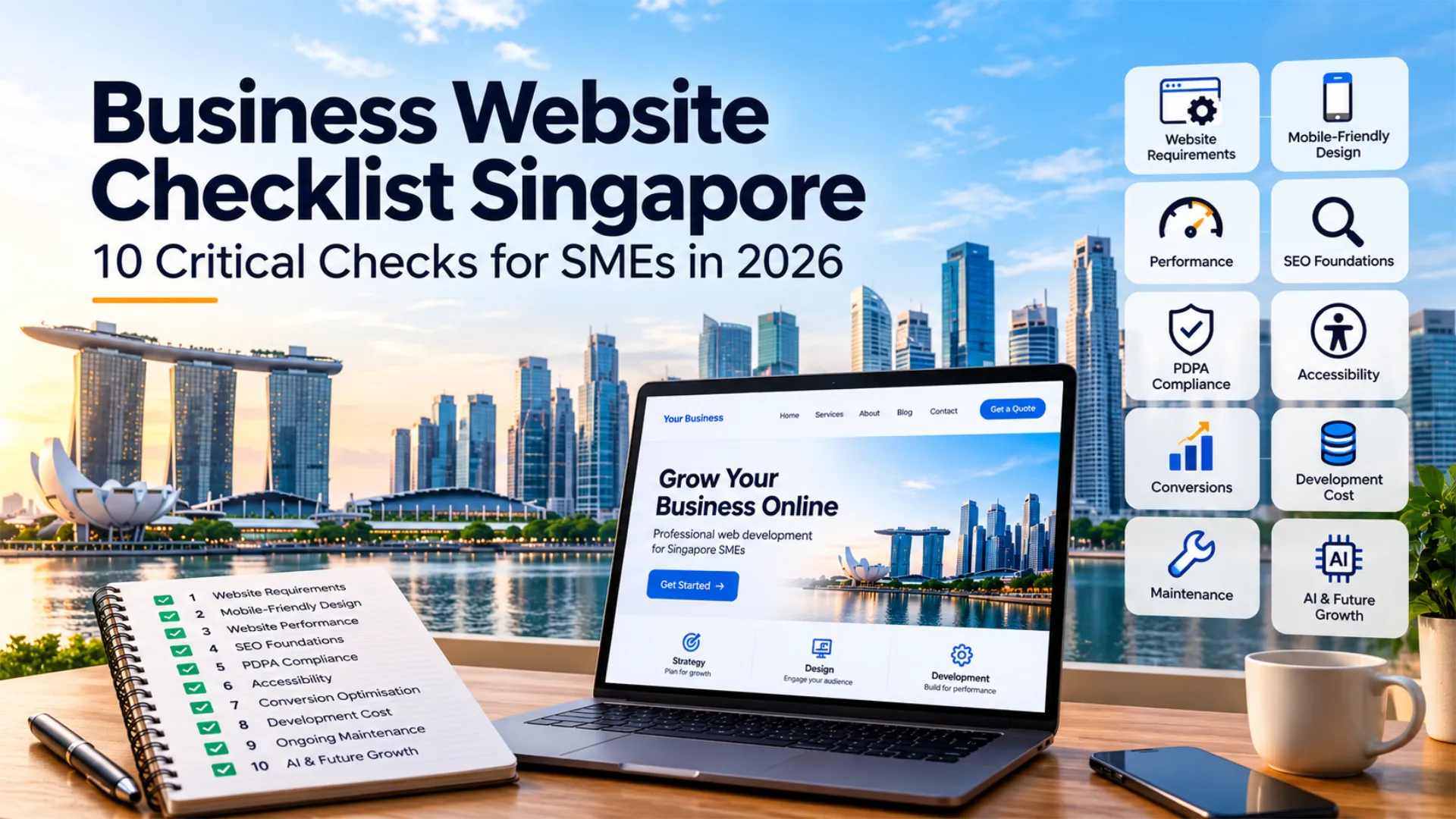
Before starting development, check that your website plan addresses these 10 areas:
| Website requirement | What to check |
|---|---|
| Business positioning and structure | Is it immediately clear what the company does and who it serves? |
| Mobile usability | Can visitors use the site comfortably on smaller screens? |
| Website performance | Does the website load quickly and remain stable while loading? |
| SEO foundations | Can search engines crawl and understand the important pages? |
| Data protection | Is personal data collected and handled appropriately? |
| Accessibility | Can a wider range of users navigate and understand the website? |
| Conversion paths | Is it easy to enquire, call, book or purchase? |
| Website cost and ownership | Is the full scope and long-term cost clear? |
| Maintenance | Who updates, secures and supports the site after launch? |
| Future and AI readiness | Can the website accommodate new content, integrations and AI tools? |
These points should be discussed before development starts. Fixing fundamental structural problems after launch is usually more disruptive than planning them properly from the beginning.
1. Website Requirements Singapore SMEs Should Define Before Design
One of the most common mistakes in website projects is moving into visual design before deciding what the website needs to achieve.
Start with the business.
What services or products need to be promoted? Who are the priority customers? What questions do prospects normally ask before contacting you? What action should a visitor take when they are ready?
These answers influence the website structure.
A service-based SME might need:
- A clear homepage
- Individual service pages
- An About page
- Case studies or examples of work
- Frequently asked questions
- Educational articles
- A contact or enquiry page
An online retailer will require a very different structure involving product categories, individual product pages, payment functionality, delivery information and customer support.
If you are planning an online store, TechWeb’s guide to e-commerce website design in Singapore explains the additional decisions businesses should make before launch.
The goal is to avoid building a five-page website simply because five pages were included in a quotation. The number and purpose of pages should follow the needs of the business and its customers.
Give every important page a purpose
A useful way to plan the site is to give each page one primary objective.
For example:
- Homepage: Explain the business and direct visitors to the right area.
- Service page: Explain a specific service and encourage enquiries.
- About page: Build credibility and explain who is behind the business.
- Article: Answer a customer question and attract relevant search traffic.
- Contact page: Make taking the next step straightforward.
This creates a stronger customer journey than placing most of the company’s information on one long homepage.
2. SME Website Singapore: Make the Mobile Experience a Priority
A modern SME website Singapore customers visit needs to work comfortably across mobile phones, tablets and desktop computers.
Mobile-friendly design is no longer about shrinking the desktop layout to fit a smaller screen. The experience should remain usable at every size.
Google uses the mobile version of website content for indexing, making consistency between mobile and desktop versions important. Google’s mobile-first indexing guidance explains what website owners should consider.
Check areas such as:
- Navigation that is easy to use on a phone
- Buttons that are large enough to tap comfortably
- Text that can be read without zooming
- Forms that are simple to complete
- Images that resize correctly
- Tables that remain usable on smaller screens
- Important information that is not hidden on mobile
- Calls to action that remain visible and clear
Responsive design should be tested on real devices rather than judged only from a desktop browser preview.
3. Website Performance Singapore Businesses Should Test
Speed and responsiveness affect how a site feels to visitors.
Google’s Core Web Vitals measure aspects of real-world user experience including loading performance, responsiveness and visual stability. The current metrics include Largest Contentful Paint, Interaction to Next Paint and Cumulative Layout Shift.
Businesses do not need to become technical experts, but they should ask their developer how performance will be tested.
Large images, unnecessary scripts, excessive plugins and poorly configured hosting can all affect website performance.
Google’s Core Web Vitals guidance provides more detail on these performance measurements.
It is also important not to treat Core Web Vitals as the only thing that matters. A useful website still needs strong content and an overall good user experience.
4. SEO-Ready Website Singapore: Build Search Foundations From the Start
An SEO-ready website Singapore businesses can grow should not depend on SEO being added as an afterthought.
Search visibility begins with how the website is structured.
Important foundations include:
- Clear page hierarchy
- Descriptive page titles
- Logical URLs
- Proper heading structure
- Internal links between related content
- Crawlable text
- Useful service pages
- Image optimisation
- XML sitemap
- Appropriate metadata
- Technical indexing controls
Google describes SEO as helping search engines understand content while helping users determine whether they should visit a site from search results. Its SEO Starter Guide provides a useful overview.
This does not mean forcing keywords into every paragraph.
It means creating pages around topics customers genuinely search for and making the website easy for both users and search engines to understand.
For a more detailed planning framework, read TechWeb’s SEO-Ready Website Development in Singapore guide.
Plan around search intent
Different searches represent different stages of the customer journey.
Someone searching:
“What does a business website need?”
is probably researching.
Someone searching:
“web development company Singapore”
may already be comparing providers.
Someone searching:
“website maintenance Singapore”
may have an existing website and a specific problem.
Your pages should reflect those differences rather than trying to rank one page for every possible search.
This also reduces the risk of multiple pages on your own website competing for the same search intent.
5. PDPA Website Requirements Singapore Businesses Should Consider
PDPA website requirements Singapore businesses need to consider depend partly on what information the website collects and how that information is used.
A simple informational site may collect very little data. A website with enquiry forms, customer accounts, online ordering, mailing lists, advertising technologies or other integrations may process considerably more.
Singapore’s Personal Data Protection Commission advises organisations building websites to consider the type and amount of personal data collected, the required level of security, hosting arrangements and website resilience.
Businesses can refer to the PDPC’s guidance on building websites and its overview of data protection obligations.
Website planning should therefore include questions such as:
- What personal data does each form collect?
- Why is that information required?
- Is the purpose of collection communicated appropriately?
- Which third-party services receive website data?
- Who has access to submitted information?
- How is the information protected?
- Is the business’s privacy information accurate?
- Who is responsible for managing data-protection matters?
A website developer can help implement technical measures, but compliance responsibilities extend beyond web design. Businesses should obtain appropriate professional advice where necessary.
Review third-party tools
Many websites rely on external services including analytics platforms, CRM systems, chat tools, advertising tags, payment gateways and email marketing systems.
These should not simply be installed because they are popular.
Understand what information they collect, why you need them and how they fit into your organisation’s data practices.
6. Website Accessibility Singapore: Design for More People
Website accessibility Singapore businesses should consider means designing websites so that people with different abilities can perceive, understand, navigate and interact with them.
The World Wide Web Consortium’s Web Content Accessibility Guidelines, commonly known as WCAG, provide internationally recognised guidance for making web content more accessible.
Practical considerations include:
- Sufficient colour contrast
- Readable text
- Alternative text for meaningful images
- Clear heading structures
- Keyboard accessibility
- Descriptive link text
- Clearly labelled forms
- Captions or alternatives for relevant multimedia
- Predictable navigation
You can refer to the W3C Web Content Accessibility Guidelines for detailed recommendations.
Accessibility should not be treated only as a compliance exercise.
Many accessibility practices improve usability for everyone, including older users, people using mobile devices and visitors navigating under less-than-ideal conditions.
7. Website Conversion Requirements Singapore Businesses Often Miss
Traffic alone does not make a website effective.
Visitors need an obvious next step.
Depending on the business, that might be:
- Request a quotation
- Book a consultation
- Call the company
- Send a WhatsApp message
- Make a purchase
- Schedule an appointment
- Download information
- Visit a physical location
A common mistake is making visitors work too hard to figure out how to proceed.
Calls to action should be visible without overwhelming the page. Forms should ask only for information that serves a clear purpose. Contact details should be easy to find.
Build trust before asking for the enquiry
Before contacting a company, potential customers may look for evidence that it is credible.
Relevant trust signals can include:
- Clear business information
- Genuine project examples
- Testimonials where appropriate
- Industry experience
- Team information
- Professional contact details
- Transparent explanations of services
- Useful educational content
Avoid filling pages with unsupported superlatives such as “best”, “leading” or “number one”.
Specific evidence is usually more convincing.
8. Website Development Cost Singapore: Understand the Full Investment
A search for website development cost Singapore can produce dramatically different quotations because websites differ substantially in scope.
Instead of asking only:
“How much does a website cost?”
ask:
“What is included in this website project?”
A quotation should make clear whether it covers:
- Planning and discovery
- Design
- Development
- Mobile optimisation
- Content writing
- Content migration
- SEO foundations
- Forms and integrations
- Analytics configuration
- Testing
- Training
- Hosting
- Maintenance
- Support after launch
A low initial figure may exclude work that later becomes necessary. A higher quotation may include services that another provider treats as additional work.
Compare scope rather than price alone.
If you are still deciding between an agency, freelancer or building the site internally, TechWeb’s web design agency vs freelancer guide provides a framework for comparing responsibilities, costs and long-term support.
Think in terms of total cost of ownership
The website will continue to incur costs after it goes live.
These may include:
- Hosting
- Domain renewal
- Premium software licences
- Security services
- Backups
- Content changes
- Technical support
- SEO
- New functionality
The cheapest build is not necessarily the lowest-cost website over several years.
A better comparison considers what the website needs to achieve and what it will cost to keep it working properly.
Make website ownership clear
Your business should understand who controls:
- Domain registration
- Hosting account
- Website administrator access
- Analytics accounts
- Search Console
- Business email configuration
- Source files where applicable
Do not wait until a relationship with a developer ends before asking these questions.
Clear ownership arrangements reduce unnecessary risk.
9. Website Maintenance Singapore: Decide What Happens After Launch
Website maintenance Singapore businesses need should be discussed before the website is completed.
Websites are not static assets.
Content changes. Software is updated. Security issues emerge. Forms need testing. Links can break. Plugins can become incompatible and business information can become outdated.
At minimum, establish who is responsible for:
- Software updates
- Backups
- Security checks
- Broken links
- Form testing
- Performance monitoring
- Content changes
- Hosting issues
- Recovery if something goes wrong
TechWeb’s website maintenance Singapore service covers ongoing updates, backups, security checks, bug fixes and technical support for businesses that do not want to manage these areas internally.
Maintenance should not be an afterthought added only after something breaks.
A clear support arrangement makes it easier to keep the website secure, accurate and useful over time.
10. AI for Business Websites Singapore: Plan for Future Growth
AI for business websites Singapore companies are exploring can range from simple content tools to customer-facing AI assistants.
The important question is not whether a website uses AI.
It is whether AI solves a real problem.
A business website might use AI to:
- Answer common customer questions
- Help visitors find relevant services
- Capture and qualify enquiries
- Assist with product discovery
- Provide after-hours support
- Route enquiries more effectively
TechWeb’s guide to AI for business websites explores how these applications can fit into a broader website strategy.
Businesses particularly interested in automated customer support can also read the AI chatbot for small business Singapore guide.
AI should not be added merely because it is fashionable. It needs clear boundaries, appropriate source information and a defined escalation route when human input is required.
The same data-protection questions that apply elsewhere on a website should also be considered when AI tools collect or process customer information.
Make the website easy to expand
Future readiness is not only about AI.
A well-planned website should also make it possible to add:
- New services
- New landing pages
- Additional articles
- E-commerce functions
- Booking systems
- CRM integrations
- Marketing automation
- Customer portals
- New analytics tools
A website that is difficult to expand can become an obstacle as the business grows.
Web Development Agency Singapore: What to Check Before Hiring
Once the 10 requirements above are clear, the next step is deciding who should build and support the website.
If you are evaluating a web development agency Singapore businesses can work with long term, look beyond the visual quality of its own website.
Ask practical questions.
Can you see genuine completed work?
Review live projects rather than screenshots alone.
Check the websites on both desktop and mobile. Look at navigation, page speed, content organisation and overall usability.
What happens before design starts?
A capable provider should first understand your business, target customers, website objectives and required functionality.
Design without discovery often produces attractive pages without a strong commercial structure.
How is SEO considered?
Ask whether the project includes planning for:
- Page structure
- URLs
- Headings
- Metadata
- Internal links
- Indexing
- Performance
“SEO-friendly” should mean something specific.
Who creates the content?
Establish whether you are supplying all text and images or whether the developer provides content support.
Content delays are one of the easiest ways for a website project to stall.
What happens after launch?
Find out who manages updates, fixes, hosting issues and future improvements.
What do you actually own?
Confirm control of your domain, website accounts and important digital assets.
For businesses that want an integrated approach, TechWeb’s web development services in Singapore combine website development with SEO, content and ongoing support.
Business Website Checklist Singapore: Final 10-Point Review
Before approving your website project, run through this final checklist.
1. Purpose and Structure
Can you clearly state what the website needs to achieve, who it serves and which pages are required?
2. Mobile Experience
Has the website been designed and tested for phones, tablets and desktop screens?
3. Performance
Has loading speed, responsiveness and visual stability been considered during development?
4. SEO
Can search engines understand, crawl and index the important content?
5. Data Protection
Do you understand what personal information the website collects, why it is required and how it is handled?
6. Accessibility
Can a broad range of visitors comfortably navigate and understand the website?
7. Conversion
Is it obvious what visitors should do next?
8. Cost and Ownership
Do you understand the full project scope, ongoing costs and who controls the important digital assets?
9. Maintenance
Is someone clearly responsible for updates, backups, security and technical support?
10. Future Growth
Can the website accommodate new pages, integrations, AI tools and changing business needs?
If several answers are unclear, the project probably needs more planning before development begins.
Conclusion: Build a Business Website That Supports Long-Term Growth
A successful business website is not simply a collection of attractive pages. It should support how customers discover the business, understand its services, evaluate its credibility and eventually make contact or complete a transaction.
That is why this business website checklist Singapore SMEs can use goes beyond design.
The strongest websites combine clear business positioning with mobile usability, good performance, SEO foundations, responsible data handling, accessibility, conversion planning, sensible budgeting, ongoing maintenance and the flexibility to evolve.
Not every business will need the same features. An e-commerce company, professional services firm and local SME may all require very different website structures. What matters is that those requirements are identified before development begins.
Taking the time to define them early can also help businesses avoid common problems such as unclear page structures, unnecessary features, weak SEO foundations, unexpected development costs and uncertainty over who maintains the website after launch.
It is also worth thinking beyond launch day. A website should be able to change as the business changes. New services may be introduced, search behaviour may evolve, customer expectations may shift and technologies such as AI may create new ways for visitors to interact with businesses online.
The objective is therefore not to build a website that is perfect for one moment in time. It is to build a strong digital foundation that can continue supporting the business.
If you are planning a new website or replacing an existing one, TechWeb can help with web development in Singapore, SEO, content, AI integration and ongoing website support.
Start with the right requirements, build on strong foundations and create a website that can grow with your business.
Frequently Asked Questions About Business Websites in Singapore
What should a business website in Singapore include?
A business website should clearly explain what the company does, who it serves and how potential customers can take the next step.
For most SMEs, important elements include clear service or product pages, mobile-friendly design, good website performance, SEO foundations, contact information, clear calls to action, appropriate data-protection measures and a plan for ongoing maintenance.
The exact website requirements Singapore businesses need will vary depending on the industry, target customers and functionality required.
How many pages should an SME website in Singapore have?
There is no ideal number of pages for every SME website Singapore businesses operate.
A simple service business may need a homepage, About page, several service pages, articles and a contact page. A more complex business may require dozens or hundreds of pages.
The better question is whether every important service, product or customer need has enough space to be explained properly.
Website structure should be based on business needs and search intent rather than an arbitrary page count.
What makes a website SEO-ready?
An SEO-ready website Singapore businesses can build on should have a logical page structure, crawlable content, descriptive URLs, useful headings, internal links, appropriate metadata, mobile usability and sound technical foundations.
SEO should ideally be considered during website planning rather than added only after development is finished.
For more detail, see TechWeb’s SEO-Ready Website Development in Singapore guide.
How important is mobile-friendly website design in Singapore?
Mobile usability is important because customers frequently access business websites from smartphones.
A mobile-friendly website should have readable text, simple navigation, appropriately sized buttons, responsive images and forms that are easy to complete.
The mobile version should also provide the important content available to desktop users.
How much does website development cost in Singapore?
Website development cost Singapore businesses encounter varies considerably according to scope.
Cost can be influenced by factors such as:
- Number of pages
- Custom design
- E-commerce functionality
- Booking systems
- Content creation
- SEO requirements
- Integrations
- Membership systems
- Custom development
- Hosting
- Ongoing maintenance
Rather than comparing quotations by headline price alone, compare what is actually included and what additional costs may arise after launch.
Does a Singapore business website need to comply with the PDPA?
Businesses that collect, use or disclose personal data through their websites should consider their obligations under Singapore’s Personal Data Protection Act.
Relevant areas can include enquiry forms, mailing lists, account registrations, analytics tools and other services that process personal information.
Businesses should understand what data is collected, why it is collected, where it goes and how it is protected. The Personal Data Protection Commission provides official guidance for organisations.
What are the most important website maintenance tasks?
Important website maintenance Singapore businesses should plan for can include:
- Software updates
- Backups
- Security monitoring
- Form testing
- Broken-link checks
- Performance monitoring
- Content updates
- Hosting support
- Recovery planning
The exact maintenance programme depends on the website platform and complexity.
TechWeb also provides website maintenance services in Singapore for businesses that prefer ongoing technical support.
Should SEO be done before or after website development?
SEO should ideally begin during planning.
Site structure, service pages, URLs, internal links, headings and content all affect how easily search engines can understand a website.
Waiting until the website is finished can mean restructuring pages or rewriting content that could have been planned correctly from the beginning.
Should a Singapore SME use an agency, freelancer or DIY website builder?
The appropriate choice depends on budget, complexity, internal expertise and the level of support required.
DIY platforms can work for straightforward requirements. Freelancers may suit clearly defined projects, while agencies can provide broader capabilities across design, development, SEO, content and ongoing support.
TechWeb’s agency vs freelancer vs DIY guide compares these options in greater detail.
Does every business website need AI?
No.
AI for business websites Singapore companies are considering should solve a specific business or customer problem rather than simply being added because AI is popular.
Useful applications can include answering common enquiries, helping visitors find services, qualifying leads or providing after-hours support.
If a normal contact form, search function or FAQ section already solves the problem effectively, AI may not be necessary.
How often should a business website be updated?
There is no fixed schedule that applies to every business.
Core information such as services, pricing, team details, contact information and policies should be updated whenever they change.
Businesses using content marketing or SEO may also publish useful new articles and improve existing pages regularly.
Technical updates, backups and security checks should form part of the site’s ongoing maintenance process.
How do I know if my existing website needs to be redesigned?
A redesign may be worth considering if the website is difficult to use on mobile devices, slow, difficult to update, no longer reflects the business, generates few enquiries or has an outdated structure.
However, a full redesign is not always necessary.
Sometimes improvements to content, SEO, navigation, page speed or conversion paths can solve the underlying problem without rebuilding the entire site.
The first step should be identifying what is actually preventing the website from performing effectively.





4 thoughts on “Business Website Checklist Singapore: 10 Critical Checks for SMEs in 2026”
Pingback: Web Hosting Maintenance Services: What Providers Don’t Tell You — Pixeldev journal
Pingback: AI for Business Websites: 8 Benefits for Singapore SMEs
Pingback: AI Chatbot Singapore: 7 Practical Ways SMEs Can Use AI
Pingback: Ecommerce Website Checklist Singapore: 12 Essential Steps