Introduction
What is SEO digital marketing? It is the use of search engine optimisation to help people find your business through unpaid search results. SEO involves improving your website’s content, technical structure and online presence so that search engines can understand your pages and show them for relevant searches.
For Singapore businesses, the aim is to attract potential customers and help them take the next step, whether that means requesting a quotation, booking an appointment or making a purchase.
This guide explains how SEO works, where it fits within digital marketing and what your business should focus on first.
How SEO Fits into Digital Marketing
Digital marketing includes several ways to reach customers online, including social media, email, paid advertising and search.
SEO focuses on organic search visibility. You do not pay a search engine for each organic click, although creating content, improving your website and maintaining its performance still require resources.
Consider a hypothetical renovation company in Singapore. A homeowner might first search for renovation ideas, then compare flooring options and eventually look for a contractor.
Different website pages can support that journey:
- A planning guide answers early questions.
- A comparison article explains the advantages and limitations of different materials.
- A service page describes the company’s capabilities.
- A portfolio helps the homeowner assess its work.
- An enquiry form makes it easier to request a quotation.
SEO connects these pages with relevant searches. The website then needs to help visitors understand the business and decide whether to enquire.
How Search Engines Find and Present Your Website
Google describes three main stages in how its search engine works:
- Crawling: Automated programmes discover and access webpages.
- Indexing: Google analyses a page and may store information about it in its index.
- Serving results: When someone searches, Google selects relevant results using its ranking systems.
Publishing a page does not guarantee that it will be indexed or appear prominently.
SEO addresses both accessibility and relevance: can search engines access the content, and does it provide a useful answer to the search?
The Three Main Areas of SEO
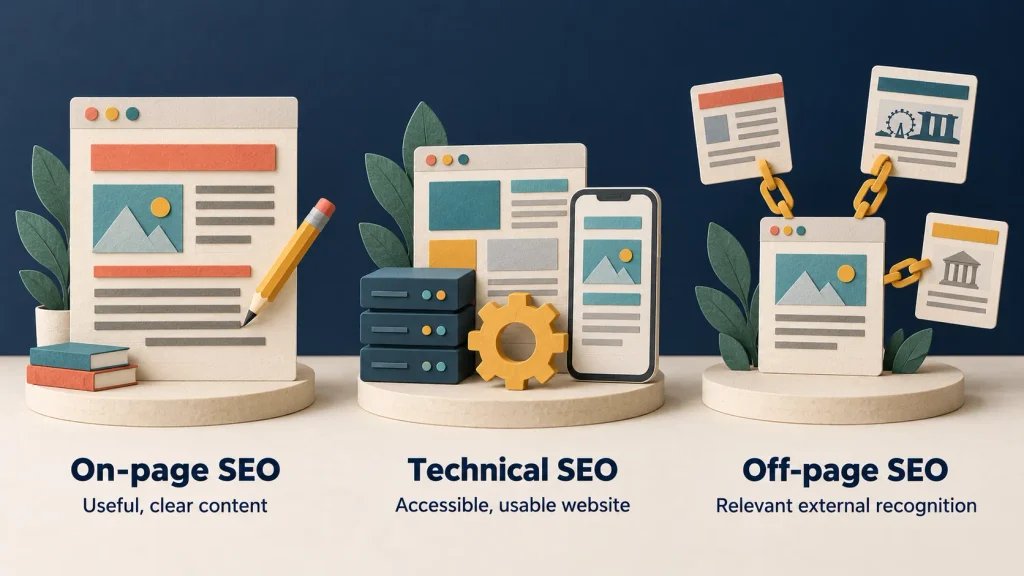
SEO is often grouped into on-page, technical and off-page work. These areas support each other, but solve different problems.
1. On-page SEO: Make Each Page Useful and Clear
On-page SEO concerns the content and organisation of individual pages.
It includes descriptive titles, logical headings, helpful explanations, relevant internal links and image descriptions that accurately reflect what an image shows.
For example, a page offering office cleaning should explain the service scope, scheduling options, areas served and quotation process. Repeating “office cleaning Singapore” throughout the page will not answer those questions.
Google’s SEO Starter Guide provides a useful introduction to making content easier for people and search engines to understand.
2. Technical SEO: Make the Website Accessible and Usable
Technical SEO addresses how a website is built and maintained.
Typical checks include:
- Whether important pages can be crawled and indexed
- Whether the website works properly on mobile devices
- Whether broken links and redirects need attention
- Whether navigation makes important content easy to find
- Whether loading problems interfere with using the site
These issues are best considered during website planning, not only after launch. Our guide to SEO-ready website development in Singapore explains how to build search considerations into that process.
3. Off-page SEO: Earn Relevant Recognition
Off-page SEO includes links and references from other websites that help establish your business’s presence beyond its own pages.
Potential opportunities include relevant industry directories, genuine partnerships, editorial coverage and resources that other organisations find useful enough to reference.
The objective should be meaningful recognition, not simply accumulating links. Google identifies links created primarily to manipulate rankings as link spam.
Search Intent: Understand What the Customer Needs
Search intent is the purpose behind a search.
Someone researching a problem needs a useful explanation. Someone comparing suppliers needs enough detail to assess their options. Someone ready to buy needs a straightforward way to proceed.
Using our hypothetical renovation company, different searches call for different content:
| Example search | Likely need | Suitable page |
|---|---|---|
| How to plan a condo renovation | Understand the process | Planning guide |
| Vinyl flooring vs tiles | Compare materials | Comparison article |
| Condo renovation contractor Singapore | Assess providers | Service page and portfolio |
| Request a renovation quotation | Discuss a project | Enquiry page |
These examples illustrate intent, rather than verified keyword demand.
Before creating a page, ask: What would someone expect to find after clicking this result?
Then check whether the page answers that question clearly. A visitor looking for service details should not have to work through a long general introduction before finding them.
Why Local SEO Matters for Singapore Businesses
Local SEO helps businesses become discoverable for searches connected to a particular location.
For an eligible business, this includes maintaining an accurate Google Business Profile with appropriate categories, contact details, opening hours and photographs. The website should also explain where the business operates and what it offers.
Google states that local results are mainly influenced by relevance, distance and prominence. Accurate, complete information helps Google understand the business, but cannot guarantee a particular position. Read Google’s guidance on improving local rankings.
For a neighbourhood shop, clinic or home-service provider, local visibility may be particularly relevant to attracting suitable enquiries. Our guide to SEO for small businesses in Singapore explores the wider business considerations.
SEO vs Paid Search: What Is the Difference?
SEO and paid search both help businesses reach people who are searching online, but their costs, timing and controls differ.
| Consideration | SEO | Paid search |
|---|---|---|
| Placement | Organic search results | Advertising placements |
| Payment for clicks | No payment to the search engine per organic click | Typically charged per click |
| Main investment | Content, technical improvements and maintenance | Advertising budget and campaign management |
| Timing | Changes take time to assess | Can generate visits once ads are approved and running |
| Control | Limited control over search placement | More direct control over targeting and budgets |
| Ongoing visibility | May continue, but is not guaranteed | Depends on active ad delivery and spending |
The term SEM is sometimes used for search marketing broadly and sometimes specifically for paid search. Clarify what a provider means when reviewing a proposal.
Your choice should reflect your business goals. An immediate promotion may benefit from paid advertising, while SEO can support ongoing discovery of services and useful resources. The two can also work together.
Does SEO Still Matter with AI Search?
Yes. Google states that established SEO practices remain relevant to AI Overviews and AI Mode. There are no additional technical requirements or special optimisations needed specifically for these features, and eligibility does not guarantee inclusion. See Google’s guidance on AI features and websites.
For businesses, this strengthens the case for content that offers specific, useful information.
A renovation company could explain how an occupied home affects scheduling, what a quotation should clarify or why a particular material suited a completed project. Verified photographs and explanations of real decisions can offer more value than another general list of renovation tips.
Google’s people-first content guidance encourages original information, clear sourcing and relevant experience. It does not prescribe a preferred word count.
What Should Your Business Improve First?
A practical SEO plan starts with priorities, rather than a long list of unrelated tasks.
Define a Business Outcome
Choose the action you want visitors to take, such as submitting a qualified enquiry, booking a consultation or completing a purchase.
This helps you decide which pages deserve attention first.
Review Your Main Service or Product Pages
Check whether visitors can quickly understand what you offer, who it is suitable for and how to proceed.
For a cleaning company, details about service frequency and what is included may matter more than another broad article about the benefits of cleaning.
Resolve Access and Usability Problems
Check indexing, mobile navigation, loading issues, broken links and enquiry forms.
A useful page cannot do its job if customers struggle to access it or contact you.
Improve One Important Topic
Choose a service or customer question that matters to your business. Strengthen the existing page before publishing several articles that repeat the same information.
Connect Related Pages
Use descriptive internal links to guide visitors between explanations, comparisons, services and contact options.
Each link should help someone continue a relevant task.
Review the Results
Use search performance and enquiry data to decide what to improve next. Record significant changes so that later comparisons have context.
How to Measure Whether SEO Is Working
A ranking improvement is useful when it contributes to relevant visibility and business activity.
The Google Search Console Performance report shows search impressions, clicks, click-through rate and average position. You can also examine performance by page and query.
Combine these indicators with website analytics and enquiry records:
| Measure | What it helps you assess |
|---|---|
| Relevant search impressions | Whether your pages appear for suitable searches |
| Organic clicks | Whether search visibility brings visits |
| Enquiries, bookings or purchases | Whether visitors take meaningful actions |
| Qualified leads | Whether enquiries match what your business offers |
| Sales and revenue | Whether those opportunities create business value |
Treat a WhatsApp click or phone-button tap as an expression of interest, not automatically as a completed enquiry.
For example, if a service page attracts more visitors but enquiries remain unchanged, review the search terms, page content and contact process before simply trying to increase traffic again.
Conclusion: Build SEO Around Your Customers and Business Goals
Understanding SEO digital marketing starts with a straightforward principle: make your business easier to discover, understand and contact. Useful content helps customers assess their options, a reliable website lets them explore without friction, and relevant recognition from other sources supports your online presence.
Start with one important service or product page. Check whether it answers the customer’s questions, works properly on mobile and provides a clear next step. Then measure whether improvements lead to more suitable enquiries or purchases. This gives your SEO work a practical purpose and a basis for deciding what to do next.
TechWeb’s SEO services in Singapore bring together technical reviews, on-page optimisation, keyword research and local SEO support. If your website is not attracting the enquiries you expected, a focused review can help identify the gaps and turn them into a prioritised improvement plan.
Frequently Asked Questions About SEO Digital Marketing
What is SEO digital marketing in simple terms?
It is the work involved in helping people find your business through organic search results. This includes improving your website’s content, technical setup and online presence so that it can appear for relevant searches.
How long does SEO take to work?
There is no fixed deadline. Google explains that some changes can be reflected within hours, while others may take several months. It generally recommends allowing a few weeks to assess the effects of changes. Business outcomes may take longer, and not every update produces a noticeable improvement. See Google’s explanation of SEO timelines.
How much does SEO cost in Singapore?
Costs depend on your website’s size, condition, competition and the scope of work. A focused audit differs from an ongoing programme covering technical fixes, content and reporting.
Compare proposals by their deliverables, implementation responsibilities and measurement approach, rather than price alone.
Can I do SEO myself?
Yes. You can start with accurate service descriptions, useful answers to customer questions and clear navigation. Specialist support may help with technical problems, website migrations or more complex planning. Google provides a useful guide to deciding whether you need an SEO professional.
Does paying for Google Ads improve organic rankings?
No. Advertising and organic rankings operate separately. Google states that buying advertising does not affect a website’s organic search presence. Its guidance on SEO and advertising explains this distinction.
Do I need to publish a blog every week?
No. Your schedule should reflect genuine customer questions and your capacity to answer them well. Improving an incomplete service page may be more useful than publishing another general article. Quality and relevance should guide the decision.
Is SEO still relevant to AI-generated search answers?
Yes. SEO fundamentals remain relevant to Google’s AI search features. However, no method guarantees that your business will be mentioned or linked in an AI-generated answer.