Introduction
AI Chatbot Singapore solutions are becoming increasingly practical for SMEs looking to improve customer service, capture leads and automate repetitive enquiries.
Modern AI chatbots have moved far beyond the simple pop-up boxes that gave customers a fixed list of questions to choose from. They can understand natural questions, search approved business information, guide customers towards suitable services and help businesses respond even when staff are unavailable.
For Singapore SMEs, this creates practical opportunities.
An AI chatbot can help answer repetitive questions, capture leads, assist customers through WhatsApp, support an online store or handle the first stage of an appointment enquiry.
But adding AI simply because it is popular is unlikely to produce good results.
The chatbot needs a clear purpose, reliable information and sensible boundaries. It also needs to know when a human should take over.
This guide explains seven practical ways businesses can use an AI chatbot in Singapore, together with important considerations around costs, PDPA, AI governance and government support.
If you are considering AI as part of a wider website strategy rather than only a chatbot, start with TechWeb’s guide to AI for Business Websites in Singapore.
What Is an AI Chatbot?
Traditional chatbots usually work through predefined rules.
A customer might select a question such as:
- What are your opening hours?
- Where are you located?
- How much does this service cost?
The chatbot then displays a prepared response.
This approach works reasonably well for simple frequently asked questions but can become frustrating when someone asks something that is not included in the menu.
An AI chatbot works differently.
It can interpret questions written in natural language.
For example, a customer might ask:
“I run a company with about 20 employees. Which package would suit me?”
Or:
“Can you deliver this product by Saturday?”
Instead of requiring the customer to choose from a fixed menu, the chatbot can understand the question and respond using relevant business information.
The important part is where that information comes from.
A business chatbot should not simply be connected to an AI model and allowed to answer anything. It should work from reliable information about your products, services, policies and processes.
That is what separates a useful business assistant from a chatbot that confidently gives customers incorrect answers.
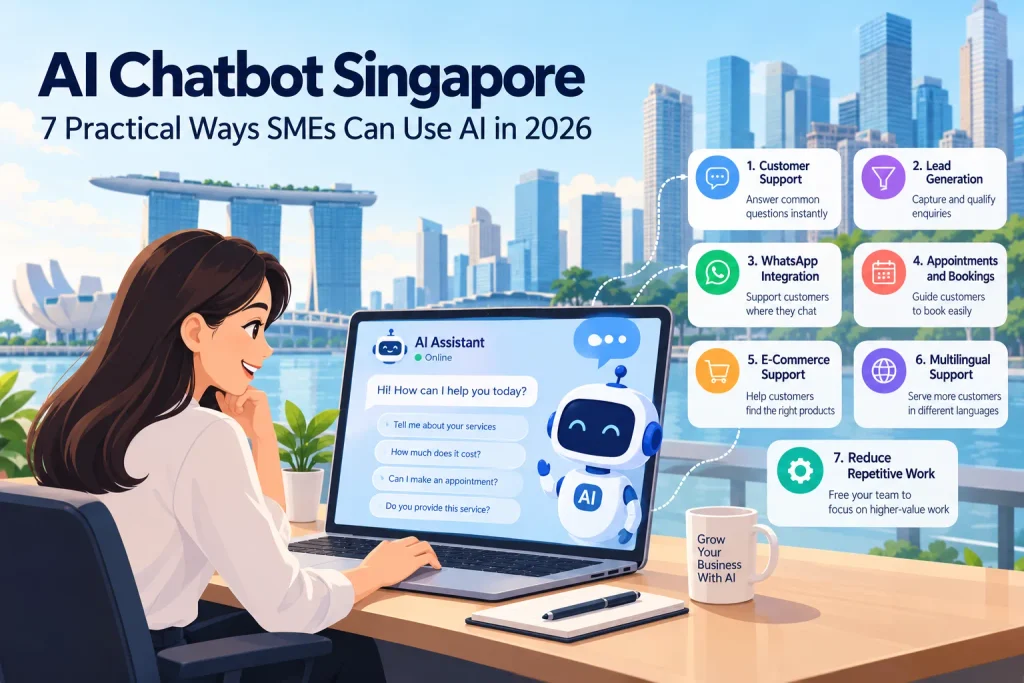
1. AI Chatbot for Customer Support in Singapore
One of the simplest ways to use an AI chatbot is to answer common customer questions.
Many businesses repeatedly receive enquiries such as:
- What are your opening hours?
- Do you provide this service?
- Where are you located?
- How much does it cost?
- How long does the process take?
- Do you deliver?
- How do I make an appointment?
A chatbot can answer many of these questions immediately.
This can be particularly useful outside normal business hours.
A potential customer may visit your website at 10 pm while comparing several providers. If they have one question before deciding whether to enquire, an immediate answer could help them continue rather than leave the website.
The chatbot does not need to replace your customer service team.
A better approach is to let AI handle routine questions while passing more complex enquiries to a person.
This provides faster first-line support without attempting to automate every conversation.
2. AI Chatbot for Lead Generation
An AI chatbot can also help convert website visitors into better-qualified leads.
Traditional contact forms often collect very little useful information.
A business may receive an enquiry such as:
“Hi, how much for website?”
Someone then needs to contact the prospect and start gathering basic details.
A chatbot can make that first interaction more useful.
For example, someone interested in website development could be asked:
- What type of website do you need?
- Do you already have a website?
- What does your business do?
- When would you like the project to begin?
The chatbot can then collect the visitor’s contact information and pass the enquiry to the appropriate person.
This gives your team more context before they begin the conversation.
There is an important balance, however.
Do not turn the chatbot into a lengthy questionnaire.
Ask only for information that helps you understand the enquiry or determine the next step.
Your website itself also needs to support lead generation effectively. TechWeb’s Business Website Checklist Singapore explains the wider areas SMEs should review, including content, calls to action, user experience, SEO and AI integration.
3. WhatsApp Chatbot Singapore Integration
For many Singapore SMEs, customer conversations eventually move to WhatsApp.
This means an AI chatbot strategy does not necessarily need to stop at the website.
Depending on the platform and integration used, a WhatsApp chatbot in Singapore could help with:
- Answering common questions
- Collecting enquiry details
- Providing service information
- Sharing basic order information
- Guiding customers towards appointments
- Passing conversations to staff
The important question is not simply whether WhatsApp automation is possible.
Ask:
Is WhatsApp already an important part of our customer journey?
If most customer enquiries eventually move to WhatsApp, incorporating it into your AI strategy may be more useful than building a sophisticated website chatbot that customers rarely use.
Information should also remain consistent across channels.
Customers should not receive one answer from your website chatbot and completely different information when they continue the conversation through WhatsApp.
4. AI Chatbot for Appointments and Bookings
Appointment-based businesses often spend considerable time answering routine administrative questions.
Customers may want to know:
- Whether a particular date is available
- What they need to prepare
- How long an appointment takes
- Where the appointment takes place
- Whether they can reschedule
An AI chatbot can handle the initial conversation.
With the right integration, it can also guide customers towards a booking system or available appointment slots.
This can be useful for businesses such as tuition centres, consultancies, professional services and other appointment-driven companies.
However, there is an important difference between answering a question and taking an action.
A chatbot that tells someone your opening hours carries relatively little risk.
An AI system that can change appointments, update customer information or access another business system requires stronger controls.
Singapore’s IMDA Model AI Governance Framework for Agentic AI recommends appropriate risk boundaries, meaningful human accountability, technical controls and transparency when organisations deploy AI agents.
The more authority an AI system has, the more important human oversight becomes.
5. AI Chatbot for E-Commerce Websites
E-commerce businesses often receive large numbers of repetitive questions.
Customers may want information about:
- Product availability
- Delivery
- Returns
- Product specifications
- Sizing
- Warranty conditions
- Order processes
A properly configured AI chatbot can answer many of these questions quickly.
It can also help customers find suitable products.
For example:
“I need a gift below $100.”
Or:
“Which model would work for a small office?”
Instead of making the customer search through dozens of product pages, the chatbot can help narrow the options.
However, product information must come from reliable sources.
An e-commerce chatbot should not invent prices, stock levels, specifications or return conditions.
Good AI therefore depends on good website and product data.
Businesses planning or improving an online store can also review TechWeb’s guide to E-Commerce Website Design Singapore for advice on website structure, mobile checkout, SEO, customer experience and e-commerce planning.
6. Multilingual AI Customer Support
Singapore businesses often serve customers who are comfortable communicating in different languages.
Modern AI systems can make multilingual customer assistance more practical.
A customer may ask a question in Mandarin, Malay or another supported language and receive a response based on the same business information used for English enquiries.
However, businesses should not assume that the chatbot performs equally well in every language.
Test it carefully using:
- Common customer questions
- Product names
- Industry terminology
- Pricing enquiries
- Customer service scenarios
Important or sensitive conversations should still have a clear route to human support.
The goal should not be to support as many languages as possible.
The aim is to provide accurate assistance in the languages that matter to your customers.
7. Reduce Repetitive Work With an AI Chatbot
One of the most valuable uses of an AI chatbot may also be one of the simplest.
Look at the questions your team answers repeatedly.
Perhaps staff are constantly replying to enquiries such as:
“Do you provide this service?”
“What does it cost?”
“Where are you located?”
“How long will it take?”
If employees spend a significant amount of time answering the same questions, those interactions may be good candidates for automation.
The chatbot can handle the first stage while employees focus on enquiries where knowledge, judgement or relationship building adds greater value.
A useful exercise is to review your last 50 customer enquiries.
Group them into categories.
You may discover that a relatively small number of questions account for a large proportion of customer interactions.
Those questions are often the best place to begin with AI.
AI Chatbot Cost Singapore Businesses Should Consider
There is no standard AI chatbot cost in Singapore because implementations vary considerably.
A basic website assistant answering FAQs is very different from an AI system connected to:
- CRM software
- Booking systems
- E-commerce platforms
- Internal databases
- Customer accounts
The total cost may include several elements.
Chatbot Platform Fees
The chatbot platform itself may charge a monthly subscription or usage-based fee.
AI Usage Costs
Some AI services charge according to usage, conversations or the amount of information processed.
Development and Integration
Connecting the chatbot to existing business systems may require custom development.
Content Preparation
The quality of the chatbot depends heavily on the information available to it.
Service details, FAQs, product information and policies may need to be organised before they can be used effectively.
Ongoing Maintenance
Business information changes.
Prices change.
Services change.
Products change.
Policies change.
The chatbot therefore needs to be reviewed and updated.
A chatbot should not be treated as something installed once and forgotten.
The same principle applies to the website supporting it. TechWeb’s Website Maintenance Singapore service covers ongoing website updates, backups, technical maintenance, security checks and keeping website information current.
AI Chatbot Singapore and PDPA
If an AI chatbot collects personal data, Singapore’s Personal Data Protection Act (PDPA) needs to be considered.
A chatbot may collect information such as:
- Names
- Email addresses
- Telephone numbers
- Company details
- Enquiry information
- Appointment information
Singapore’s Personal Data Protection Commission identifies obligations relating to areas including notification, consent, purpose limitation, accuracy, protection and retention of personal data.
Businesses should refer to the official PDPC Data Protection Obligations guidance when planning systems that collect or process personal information.
From a practical perspective, ask:
What information does the chatbot collect?
Why do we need it?
Where is it stored?
Who can access it?
Is the information being sent to another service?
Avoid collecting unnecessary information simply because the chatbot is capable of asking for it.
The purpose of the chatbot should determine what information is needed.
AI Governance for Singapore Businesses
AI governance does not mean every website chatbot is subject to a complicated new set of rules.
However, businesses should think carefully about what authority they give AI systems.
IMDA’s Model AI Governance Framework for Agentic AI provides guidance for organisations developing or deploying AI agents.
Its recommendations include managing risks, setting appropriate boundaries, maintaining human accountability, using suitable technical controls and supporting transparency.
This becomes increasingly important as AI moves from simply answering questions to taking actions.
Consider the difference.
Lower Risk
The chatbot answers:
“What time do you close?”
More Responsibility
The chatbot recommends:
“Based on what you told me, this service may suit you.”
Greater Responsibility
The chatbot books an appointment and updates customer information.
Higher Responsibility
The AI accesses multiple systems and carries out business processes automatically.
The greater the authority given to the AI, the more important safeguards and human oversight become.
Can Singapore SMEs Get Grants for AI Chatbots?
Singapore’s business grant structure changed on 30 September 2026.
The previous Productivity Solutions Grant, Enterprise Development Grant and Market Readiness Assistance programmes ceased for new applications on 29 September 2026.
Businesses applying from 30 September 2026 onwards use the new EDGE Grant framework.
Enterprise Singapore describes EDGE as covering several areas of business development, including Automation & Digitalisation.
Businesses considering AI or digital transformation projects should review the current Enterprise Singapore EDGE Grant requirements before making purchasing decisions.
However, businesses should not assume that installing a standalone chatbot automatically qualifies for grant support.
For example, Enterprise Singapore’s Large-scale Digital Transformation category includes areas such as artificial intelligence, machine learning, workflow automation and system integration.
Eligibility depends on the scope and nature of the project.
A broader digital transformation project may therefore be treated differently from simply installing a chatbot on an existing website.
Always check the current Enterprise Singapore requirements before committing to a project based on expected grant support.
How to Choose the Right AI Chatbot
Do not begin by asking:
“Which AI chatbot platform should we buy?”
Start with:
“What problem are we trying to solve?”
If your problem is missed enquiries after business hours, start with customer support.
If your team spends too much time qualifying enquiries, focus on lead generation.
If customers mainly communicate through WhatsApp, investigate WhatsApp integration.
If your e-commerce team repeatedly answers delivery and product questions, begin there.
Once the use case is clear, determine:
- What questions should the chatbot answer?
- What information does it need?
- Where will that information come from?
- What information should it never provide?
- When should the conversation go to a person?
- Does it need access to another business system?
- How will its performance be reviewed?
A simple chatbot that performs one useful function reliably is better than an ambitious chatbot that frequently provides incorrect information.
Your Website Still Matters
An AI chatbot cannot compensate for a poor website.
If visitors cannot understand what your business does, your content is outdated or your pages are difficult to navigate, adding AI does not solve the underlying problem.
The website remains the foundation.
It contains the service information, product information, policies and content that both customers and AI systems rely on.
Businesses planning AI integration should therefore also review:
- Website structure
- Service content
- Mobile usability
- Page speed
- Calls to action
- SEO
- Content accuracy
- Website maintenance
TechWeb’s SEO-Ready Website Development Singapore guide explains why website structure, content and search intent should be considered during development rather than added only after launch.
Businesses reviewing their wider website strategy can also use the Business Website Checklist Singapore to identify areas that may need improvement before introducing more advanced AI features.
How TechWeb Approaches AI Chatbot Development in Singapore
At TechWeb, we believe the first question should not be:
“Which AI tool should we install?”
The better question is:
“Where could AI genuinely improve the customer journey?”
For one business, that may mean answering common questions outside office hours.
For another, it may be qualifying potential customers before a sales conversation.
For an online store, AI could help customers find suitable products.
For another company, WhatsApp automation may provide more value than a chatbot placed on the website.
The technology should follow the business requirement.
A practical AI chatbot implementation may consider:
- Website content
- Customer questions
- Lead generation
- WhatsApp integration
- Business system integrations
- Data handling
- Human escalation
- Ongoing improvement
AI works best when it becomes part of the wider digital experience rather than an isolated widget added to the corner of a website.
That is why AI chatbots should also be considered within the broader move towards AI for Business Websites in Singapore.
Conclusion: Start With One Useful AI Chatbot Application
AI chatbots can help Singapore SMEs respond faster, reduce repetitive enquiries and create better customer experiences.
But successful AI adoption does not require automating everything.
Start with one real problem.
Perhaps customers frequently ask the same questions after office hours.
Perhaps your team spends too much time qualifying enquiries.
Perhaps shoppers struggle to find the right product.
Solve that problem first.
Then review the results before expanding the chatbot into other areas.
The businesses that gain the most value from AI are unlikely to be those using the greatest number of AI tools.
They will be businesses that use AI where it creates genuine value, connect it to accurate information and retain human involvement where judgement matters.
Frequently Asked Questions About AI Chatbots in Singapore
What is an AI chatbot?
An AI chatbot is software that uses artificial intelligence to understand questions and generate conversational responses.
Unlike basic rule-based chatbots, modern AI systems can interpret different ways of asking the same question and respond using relevant business information.
Are AI chatbots suitable for small businesses in Singapore?
Yes, particularly when the business has a clear problem it wants to solve.
Small businesses can use AI chatbots for customer support, lead generation, appointment enquiries, product discovery and repetitive customer questions.
The best approach is usually to begin with one useful application rather than trying to automate everything immediately.
Can an AI chatbot work with WhatsApp?
Yes.
Depending on the platform and implementation, an AI chatbot can be integrated with WhatsApp business messaging.
Whether your business needs this depends on how customers already communicate with you.
Does an AI chatbot need to comply with PDPA?
If the chatbot collects, uses or discloses personal data, the organisation needs to consider its obligations under Singapore’s PDPA.
Businesses should understand what information is collected, why it is required, where it is stored and how it is protected.
The official PDPC Data Protection Obligations page provides further guidance.
Is Singapore’s AI governance framework a law?
IMDA’s Model AI Governance Framework provides guidance for responsible AI deployment.
It addresses areas such as risk boundaries, human accountability, technical controls and transparency.
It should not be interpreted as a specific law imposing identical requirements on every simple website chatbot.
Can an AI chatbot qualify for a Singapore government grant?
Potentially.
Singapore’s new EDGE Grant framework includes Automation & Digitalisation activities but eligibility depends on the nature and scope of the project.
Businesses should not assume that installing a standalone chatbot will automatically qualify.
Check the latest EDGE Grant information from Enterprise Singapore before planning a grant-supported project.
How much does an AI chatbot cost in Singapore?
There is no single standard price.
Costs depend on the chatbot platform, AI usage, customisation, integrations, conversation volume and ongoing management.
A basic FAQ chatbot will generally require less implementation than a system connected to WhatsApp, a CRM, an e-commerce platform or a booking system.
Should I add an AI chatbot to an existing website?
Yes, if there is a clear business reason for doing so.
However, if the website contains outdated information, confusing navigation, poor mobile usability or weak service pages, address those issues first.
A chatbot works best when it is built on top of an accurate, well-structured website.