Introduction
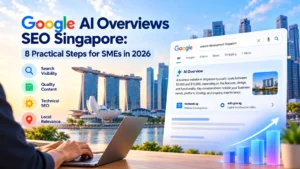
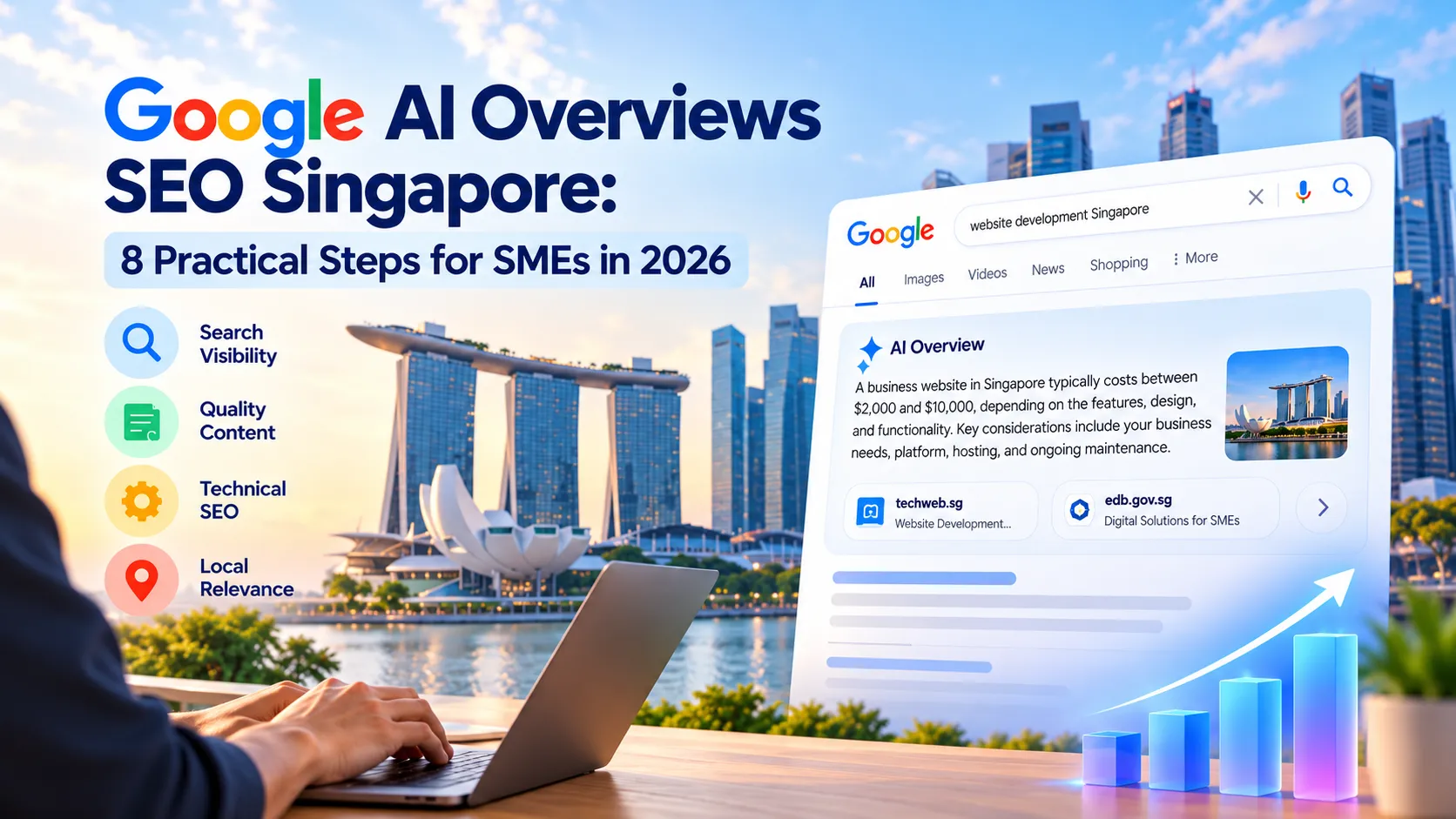
Google AI Overviews SEO Singapore is becoming an important consideration for businesses that depend on organic search traffic to attract customers.
For years, search engine optimisation (SEO) focused largely on helping websites achieve higher positions in Google’s search results. Businesses invested in relevant keywords, quality content, backlinks and technically sound websites to increase their visibility.
However, Google’s AI-powered search features are changing how people discover information.
Instead of clicking through several websites, users may now see an AI-generated answer directly within Google Search. These answers can include links to supporting websites, giving businesses additional opportunities to be discovered while potentially reducing clicks to traditional organic results.
For Singapore SMEs, this raises several important questions:
- Will Google AI Overviews reduce website traffic?
- Can smaller businesses compete with established websites for visibility in AI-generated answers?
- Does traditional SEO still work?
- What practical changes should businesses make to their websites?
The answer is not to abandon SEO. It is to strengthen the fundamentals while adapting content and measurement strategies to the changing search experience.
In this guide, TechWeb explains how Google AI Overviews affect search visibility and outlines eight practical steps Singapore businesses can take to remain competitive in 2026.
What Are Google AI Overviews and How Do They Affect SEO in Singapore?
Google AI Overviews are AI-generated responses that appear within selected Google Search results. They help users explore questions by presenting summarised information supported by links to relevant websites.
For example, someone searching for “How much does a business website cost in Singapore?” might encounter an AI Overview discussing typical pricing considerations, website features and factors affecting development costs.
The user can explore the supporting sources for further information.
However, some users may find enough information in the generated response without visiting another website.
This creates two important changes for businesses.
First, high Google rankings do not guarantee the same volume of website clicks as before.
A website may maintain strong organic rankings while receiving fewer visits from certain informational searches.
Second, being included as a supporting source in Google’s AI-generated results creates another opportunity for visibility.
Businesses with relevant, useful and trustworthy content may be discovered through links included in AI-powered search experiences.
Google also offers AI Mode, a separate conversational search experience that supports more complex questions and follow-up searches.
Importantly, AI Overviews do not appear for every search. Their appearance and supporting links can change depending on the query and Google’s systems.
According to Google’s official guidance on AI search features, established SEO practices remain relevant to both AI Overviews and AI Mode.
Are Google AI Overviews Reducing Organic Traffic?
Research suggests that AI Overviews can substantially affect click-through rates for some searches.
In February 2026, Ahrefs published an updated study examining approximately 300,000 keywords.
The researchers found that the presence of AI Overviews was associated with an estimated 58% lower average click-through rate for the top-ranking organic page, compared with an expected rate based on their methodology.
Source: Ahrefs, AI Overviews Reduce Clicks by 58%, February 2026.
This finding should be interpreted carefully.
It represents an estimate derived from the study’s keyword sample and methodology. It does not mean that every Singapore website will lose 58% of its traffic or that AI Overviews are responsible for every decline in organic clicks.
Actual performance depends on search intent, industry, ranking position and the type of content.
Nevertheless, the research demonstrates why businesses should look beyond traditional rankings when evaluating SEO performance.
1. Audit Your AI Search Visibility in Singapore
The first step towards improving visibility is understanding how AI-powered search affects your existing website.
Rather than immediately rewriting every article, identify which pages currently attract search traffic and which search queries matter most to your business.
Identify your important search queries
Start by reviewing the keywords and topics responsible for organic traffic.
For a Singapore web design agency, these might include:
- Web design Singapore
- Website development cost Singapore
- WordPress vs Shopify for small businesses
- Website maintenance Singapore
- How to improve website SEO
Search these topics and observe whether Google displays an AI Overview.
Pay particular attention to informational and comparison queries, where users are looking for explanations, recommendations or guidance.
However, do not assume that every informational query generates an AI Overview or that commercially focused searches are unaffected.
Google determines when to display these features based on the individual query.
Evaluate which pages need improvement
For each important page, consider:
Search visibility: Does the page rank for relevant queries?
Search intent: Does the content answer what users are actually asking?
Content quality: Does it offer useful information beyond what is already widely available?
Business relevance: Does it lead readers towards an appropriate service or next step?
Competition: Are other websites providing clearer explanations, stronger evidence or more useful examples?
For instance, a Singapore accounting firm might attract traffic through an article explaining company incorporation requirements.
If that article provides only a basic summary, readers may obtain sufficient information from an AI Overview.
A more valuable resource could include a detailed comparison of incorporation options, practical considerations, common mistakes and links to relevant government guidance.
The goal is not merely to make an article longer. It is to make the information more useful.
TechWeb recommendation: Begin with your ten most important organic landing pages. Improve those pages before investing heavily in new content.
2. Use Google Search Console to Measure AI Search Performance
One of the most significant developments in 2026 is the introduction of dedicated reporting for generative AI search visibility.
Google announced its Generative AI performance reports in June 2026 and confirmed their worldwide rollout on 31 August 2026.
These reports help website owners understand how frequently links to their websites appear within supported AI-powered Google Search features.
What can businesses measure?
The Google Search Console Generative AI performance report provides information about:
- Impressions: How often links to your website are displayed within supported generative AI search features
- Pages: Which URLs receive the most or fewest impressions
- Countries: Where those impressions originate
- Devices: Whether visibility comes from mobile, desktop or tablet searches
- Dates: How impressions change over time
The report covers AI Overviews and AI Mode.
You can learn more through the official Google Search Console Generative AI performance documentation.
How to review your AI search visibility
- Sign in to Google Search Console.
- Select your verified website property.
- Open the Generative AI performance report.
- Review impressions over the available reporting period.
- Identify pages attracting AI search impressions.
- Filter by country to understand visibility from Singapore.
- Compare the results with conventional organic search performance.
If the report does not appear, your website may not have accumulated sufficient qualifying impressions.
An important distinction: The dedicated Generative AI report focuses on impressions. It should not be treated as a complete report of AI-generated clicks, conversions or individual query-level citation rankings.
For traffic and business outcomes, combine Search Console information with Google Analytics and your enquiry records.
What should Singapore businesses look for?
Suppose an article attracts significant impressions in AI search but relatively few organic visits.
That does not automatically mean the article is performing poorly.
Instead, examine whether the page is reaching relevant audiences, whether its organic traffic has changed and whether visitors who arrive are becoming enquiries or customers.
AI search visibility is useful, but business results remain the ultimate measure of success.
3. Strengthen Technical SEO for AI Search
A well-structured website remains essential for search visibility.
Google’s AI features use information from its Search index. A page must generally be indexed and eligible to appear with a snippet in Google Search to qualify as a supporting link.
This makes technical SEO for AI search an important foundation.
Ensure important pages are crawlable and indexable
Search engines must be able to access and understand your website.
Review the following:
Robots.txt configuration
Make sure important pages are not accidentally blocked from Googlebot.
Indexing status
Use Google Search Console to identify pages that have not been indexed and investigate the reasons.
XML sitemaps
Maintain a sitemap containing the canonical URLs you want Google to discover.
Canonical tags
Help Google identify the preferred version of pages that have duplicate or substantially similar content.
Internal linking
Connect related pages so visitors and search engines can navigate between relevant topics.
These practices are part of creating an SEO-ready website in Singapore.
Improve page speed and mobile usability
Website performance also influences the user experience.
Businesses should regularly assess page loading performance, especially on mobile devices.
Useful improvements include optimising large images, reducing unnecessary scripts, managing caching and avoiding excessive third-party plugins.
Google’s PageSpeed Insights can help identify opportunities for improvement.
While a faster website does not guarantee inclusion in an AI Overview, it supports a better overall website experience.
Use structured data appropriately
Structured data can help search engines understand eligible content and enable certain rich search results.
For example, a business website may benefit from appropriate organisation, product, service-related or article information, depending on the applicable Google-supported markup.
However, structured data does not guarantee AI citations.
Google has explicitly clarified that special AI schema, dedicated AI markup and llms.txt files are not required for inclusion in Google AI Overviews.
Rather than pursuing unsupported technical shortcuts, businesses should prioritise sound website architecture and established SEO practices.
A well-maintained website is also less likely to accumulate unresolved technical problems. Regular website maintenance in Singapore can help keep content, plugins, security and website performance under control.
4. Create Helpful Content That Answers Search Intent
Content remains central to SEO, but the standard for useful information is increasingly important.
Generic articles that simply repeat information already available elsewhere give readers little reason to visit a website.
A stronger approach is to create content that addresses a specific problem and helps the reader make an informed decision.
Answer the main question clearly
Consider someone searching for:
“How much does it cost to develop an e-commerce website in Singapore?”
An article that begins with several paragraphs explaining why websites are important may frustrate the reader.
A more useful article would explain the main pricing factors upfront before exploring the details.
These might include website complexity, product catalogue size, payment integration, shipping requirements, hosting and ongoing maintenance.
The article could then provide a pricing framework, illustrative scenarios and questions to ask prospective developers.
The objective is to provide a helpful answer, not simply repeat the search phrase.
Organise content logically
Use descriptive headings to guide readers through related information.
For example:
- What affects e-commerce website pricing?
- WordPress vs Shopify: Which platform is more suitable?
- What ongoing costs should SMEs consider?
- How should a business compare quotations?
This type of structure helps readers find relevant sections.
It also improves the clarity of the page for search engines, although no particular heading format guarantees inclusion in AI-generated results.
Combine useful explanations with original information
Google’s 2026 generative AI optimisation guidance emphasises content that provides unique value.
Businesses should therefore look for opportunities to publish information informed by real experience.
Examples include implementation advice, detailed comparisons, practical checklists, original research and evidence-based case studies.
TechWeb’s approach to SEO content creation in Singapore is especially relevant here.
Content should not exist simply to fill a blog calendar. Each article should address a genuine customer question and contribute to a broader digital strategy.
5. Improve AI Search Optimisation With Original Singapore-Specific Content
For Singapore SMEs, local relevance can provide an important way to differentiate content.
International SEO articles often offer broadly applicable advice but may overlook the operating conditions of Singapore businesses.
A local article can provide greater value when it addresses relevant regulations, business practices, customer expectations and services.
Focus on genuine local considerations
A Singapore business website guide might discuss:
Business registration and identification
Explain how accurate business details contribute to trust and direct readers to ACRA when discussing company registration information.
Personal data protection
Discuss website forms and customer information with reference to guidance from the Personal Data Protection Commission.
Local payment options
Compare relevant payment integrations, such as supported card payments and PayNow-enabled payment solutions, when appropriate for the business.
Customer behaviour
Explain considerations such as mobile-friendly enquiry forms, clear contact information and convenient ways for customers to request quotations.
The information should be accurate, current and relevant to the article’s purpose.
Example: Generic content versus useful Singapore-specific content
Consider two hypothetical articles targeting business website development.
Article A: “10 Benefits of Having a Business Website”
It explains that websites improve visibility, support marketing and allow customers to find business information.
These points may be correct, but they are widely available.
Article B: “Business Website Checklist for Singapore SMEs”
It explains what a business should prepare before commissioning a website, including service pages, enquiry forms, privacy considerations, domain ownership, payment options and ongoing maintenance.
Article B offers more direct assistance to a Singapore business owner planning a website.
This is the type of useful, decision-oriented resource businesses should aim to publish.
For a practical example, explore TechWeb’s business website checklist for Singapore SMEs.
Avoid artificial local optimisation
Adding the word “Singapore” repeatedly does not automatically make an article locally useful.
Relevant content should demonstrate actual knowledge of the audience and its needs.
Businesses should also avoid generating large numbers of nearly identical location pages that offer little original value.
The priority is genuine local relevance rather than keyword repetition.
6. Strengthen Website Authority, Expertise and Trust
Search visibility is not just about publishing more content.
Readers need confidence that the information comes from a credible source.
Google’s E-E-A-T framework describes four qualities associated with helpful content:
Experience: Knowledge gained through direct involvement or practical application.
Expertise: Demonstrated understanding of the subject.
Authoritativeness: Recognition as a credible source of information.
Trustworthiness: Accuracy, transparency and reliability.
Google clarifies that E-E-A-T is not itself a single ranking factor. Its systems use multiple signals to identify content associated with these qualities.
Source: Google’s guidance on helpful, reliable, people-first content.
How can Singapore SMEs demonstrate credibility?
Start with transparent business information.
Make it easy for visitors to identify who operates the website, what the business offers and how to contact it.
Where appropriate, include author information and relevant qualifications.
For service businesses, verified project examples can be particularly valuable.
A website development agency, for instance, could describe:
- The problem a client needed to solve
- The technical or content approach used
- The implementation process
- The measurable results, where reliable data is available
- The lessons other businesses can apply
Such information demonstrates experience more effectively than broad claims about being an industry leader.
Publish evidence, not unsupported promises
Businesses should avoid making statements such as “guaranteed first-page rankings” or “guaranteed Google AI citations”.
Search results are dynamic and no legitimate agency can promise specific placements in Google’s AI-generated answers.
Trust is better established through clear explanations, transparent methods and verifiable outcomes.
For TechWeb, publishing practical website development insights, technical problem-solving articles and authentic client case studies can strengthen the website’s value to prospective customers.
7. Combine Local SEO Singapore Strategies With Commercial Search Intent
Although AI-generated answers are changing information discovery, businesses still need to attract customers who are ready to enquire, compare providers or make purchases.
This makes commercial SEO and local search optimisation important components of a broader strategy.
Strengthen your service landing pages
A service page should explain what a business offers and help visitors decide whether the service meets their needs.
For example, a page targeting “website maintenance Singapore” should ideally provide:
Service scope: What maintenance activities are included?
Business benefits: How does ongoing maintenance reduce operational risk?
Process: How are requests, updates and support handled?
Pricing transparency: What costs or pricing considerations should customers understand?
Next step: How can the visitor request assistance?
Informative blog articles can support these pages by answering related questions and linking naturally to the relevant service.
This creates a journey from research to enquiry.
Optimise your Google Business Profile
Businesses eligible for a Google Business Profile should maintain accurate and complete information.
Important areas include business categories, contact details, opening hours, relevant services, photographs and genuine customer reviews.
According to Google’s local ranking guidance, local results are primarily influenced by relevance, distance and prominence.
Businesses should also ensure that their website supports the services and locations they genuinely serve.
A Google Business Profile can improve discoverability across relevant Google experiences, but it does not guarantee an AI Overview citation.
Connect informational searches to conversion opportunities
Consider a business owner researching the differences between traditional websites and AI-enabled websites.
An educational article can explain the technology and its applications.
It can then direct readers towards a relevant service or another helpful resource.
For example, TechWeb’s guide to AI for business websites in Singapore explores how AI features can support modern business websites.
This approach helps create a connected content strategy rather than a collection of unrelated blog posts.
8. Measure SEO Results and Build a Sustainable AI Search Strategy
The final step is to connect search visibility with meaningful business outcomes.
Traditional SEO reporting often emphasises rankings, impressions and organic traffic.
These remain useful, but they should be evaluated alongside engagement, enquiry quality and conversion performance.
Track the right indicators
A practical SEO performance review should consider several areas.
| Metric | What it tells you |
|---|---|
| Organic impressions | How often pages appear in conventional Google search results |
| Organic clicks | How frequently users visit through search results |
| Click-through rate | The relationship between organic clicks and impressions |
| AI search impressions | How often website links appear in supported Google generative AI features |
| Landing-page engagement | Whether visitors interact meaningfully with website content |
| Enquiries and conversions | Whether website visits produce useful business outcomes |
| Qualified leads | Whether enquiries come from relevant potential customers |
Use Search Console for search visibility data and analytics or CRM tools for onsite behaviour and enquiries.
Be careful when interpreting changes in individual metrics.
A reduction in organic clicks could result from several factors, including search demand, ranking changes, competitors, seasonality or AI-generated results.
Continue improving existing content
SEO should be treated as an ongoing process.
Review important pages periodically to identify outdated information, broken links, unclear explanations and missing content.
When updating an article, focus on improvements that genuinely help readers.
For example, an existing guide to website pricing could be strengthened with updated cost considerations, better comparisons and answers to frequently asked questions.
There is no need to change publication dates simply to make content appear new.
Diversify your digital visibility
Businesses should also avoid relying entirely on one source of website traffic.
Depending on the audience, useful supporting channels might include LinkedIn, YouTube, email marketing, referrals and other appropriate digital platforms.
Educational videos can complement written guides by explaining complex topics and reaching people who prefer visual content.
For example, an article about website SEO can be supported by a short video demonstrating how to review search performance in Google Search Console.
The article and video can then direct interested viewers to relevant resources or services.
A sustainable digital strategy combines useful content, search visibility and direct customer relationships.
Google AI Overviews SEO Checklist for Singapore SMEs
Before investing in major SEO changes, use this checklist to assess your website’s readiness.
- Verify your website in Google Search Console.
- Review important keywords and pages for possible AI Overview exposure.
- Check the Generative AI performance report where data is available.
- Confirm that important pages are indexed and accessible.
- Review page speed and mobile usability.
- Improve articles that provide generic or outdated information.
- Add original examples, credible references and relevant Singapore-specific details.
- Strengthen internal links between articles and related service pages.
- Review business information and Google Business Profile details.
- Monitor organic traffic, enquiries and conversions.
- Establish a regular content review and improvement schedule.
Completing these activities does not guarantee inclusion in AI Overviews. It creates a stronger foundation for visibility in both traditional and AI-powered Google Search.
Frequently Asked Questions About Google AI Overviews SEO Singapore
1. Will Google AI Overviews replace traditional SEO?
No. Traditional SEO remains important.
Google has confirmed that foundational SEO practices continue to support visibility in its AI-powered search features.
Websites still need accessible pages, useful content, relevant information and a good user experience.
The main change is that businesses must assess search visibility in a broader context rather than focusing exclusively on conventional organic rankings.
2. How can my Singapore business appear in Google AI Overviews?
There is no guaranteed method for securing a supporting link in an AI Overview.
Businesses should follow Google’s established SEO guidance, ensure important pages can be indexed and publish accurate, relevant and useful content.
Original insights, practical experience and clear explanations can make content more valuable to readers.
However, Google ultimately determines which pages are displayed for each search.
3. Is AI search optimisation different from traditional SEO?
Terms such as AI search optimisation, Answer Engine Optimisation (AEO) and Generative Engine Optimisation (GEO) are commonly used to describe strategies aimed at visibility in AI-generated answers.
For Google Search, the underlying foundations continue to overlap substantially with established SEO.
Google does not require special AI-only markup, llms.txt files or a separate set of technical optimisation procedures.
Businesses should be cautious about services promising results through unsupported AI search techniques.
4. How do I know whether AI Overviews are affecting my website traffic?
Start by reviewing organic traffic and search performance over time.
Look for changes in impressions, clicks, click-through rates and rankings across your most important pages.
Next, review the Generative AI performance report in Search Console to understand where your website appears within supported AI-powered search experiences.
These measurements can help identify trends, but they do not automatically establish that AI Overviews caused a particular traffic change.
5. Should Singapore SMEs continue investing in SEO in 2026?
Yes, provided the investment is aligned with measurable business objectives.
SEO remains a channel through which potential customers discover services, compare providers and research solutions.
A sensible strategy combines technical improvements, quality content, local relevance, appropriate service landing pages and ongoing performance monitoring.
Businesses should assess the value of SEO through qualified enquiries and conversions rather than rankings alone.
6. Do small businesses need expensive AI SEO tools?
Not necessarily.
Google Search Console, Google Analytics and PageSpeed Insights provide useful information for understanding website performance.
Additional tools can support research, auditing and reporting, but they should be selected based on actual business needs.
For smaller businesses, resolving fundamental website problems and improving important pages may provide greater practical value than purchasing multiple specialist tools.
7. How long does it take to improve AI search visibility?
There is no fixed timeframe.
Changes to website content and technical SEO can take time to be crawled, indexed and reflected in search results.
The outcome depends on the competitiveness of the topic, the quality and relevance of the content, the website’s existing position and Google’s systems.
Businesses should evaluate performance over meaningful periods and avoid expecting immediate or guaranteed AI citations.
Conclusion: SEO Is Evolving, Not Disappearing
Google AI Overviews are changing how people discover and consume information.
For Singapore businesses, this creates challenges for traditional organic traffic but also opportunities to reach potential customers through newer search experiences.
The appropriate response is not to abandon established SEO practices or pursue every emerging AI optimisation technique.
Instead, businesses should focus on building technically sound websites, creating valuable content, demonstrating genuine expertise and measuring results that matter.
The eight steps covered in this guide provide a practical starting point:
- Audit your AI search visibility.
- Measure generative AI impressions through Search Console.
- Strengthen technical SEO.
- Create content aligned with search intent.
- Publish original Singapore-specific information.
- Demonstrate experience, expertise and trust.
- Connect local SEO with commercial search opportunities.
- Track results and continually improve your digital strategy.
The goal is not simply to appear in more search results. It is to help the right customers discover your business, trust your expertise and take meaningful action.
Is Your Singapore Business Ready for AI-Powered Search?
As Google Search evolves, your website needs a digital strategy that connects visibility with business growth.
At TechWeb, we help Singapore businesses develop SEO-ready websites, improve website content and create digital experiences designed around their customers’ needs.
Whether you are building a new website, refreshing existing content or reviewing your SEO strategy, we can help you identify practical opportunities for improvement.
Talk to TechWeb about your website and SEO strategy
Build a stronger digital presence with TechWeb.