

Introduction
For Singapore SMEs, a website can no longer be treated as a simple online brochure. Customers search before they enquire, compare before they trust and leave quickly when a website feels slow, unclear or outdated.
Singapore is already a highly connected market. DataReportal’s Digital 2026 Singapore report recorded 5.78 million internet users in Singapore at the end of 2025, with internet penetration standing at 98.4%. In this environment, your website needs to do more than look professional. It needs to be planned so people can find it, understand it and take action.
That is where SEO-ready website development in Singapore becomes important.
An SEO-ready website is not a website that has keywords added only after launch. It is a website planned from the beginning with clear structure, crawlable pages, strong content direction, fast performance, mobile-friendly design and practical conversion paths.
For SMEs, this means your website becomes a long-term business asset instead of a one-time design project.
At TechWeb, we approach website development with this long-term view: clear structure, SEO-ready foundations and practical support for businesses that want stronger visibility, credibility and growth.
What Is SEO-Ready Website Development?
SEO-ready website development means building a website with both users and search engines in mind from the start.
Google’s SEO Starter Guide explains that SEO is about helping search engines understand your content and helping users decide whether they should visit your site through search. For SMEs, this means your website should be planned clearly from the beginning, not fixed with SEO patches only after launch.
A strong SEO-ready SME website should include:
- Clear service pages
- Logical navigation
- Fast loading speed
- Mobile-friendly layouts
- Helpful content
- Trust signals
- Clear calls to action
- Room for future content growth
In simple terms, your website should answer three questions quickly:
What do you offer?
Why should customers trust you?
What should they do next?
If your website cannot answer these questions clearly, visitors may leave before they understand the value of your business.
Why SEO-Ready Website Development Matters for Singapore SMEs
Many SMEs only think about SEO after the website is launched. This often creates problems.
The design may look good, but the pages may not target the right search terms. The navigation may look modern, but Google may struggle to understand the page hierarchy. The homepage may be attractive, but service pages may be too thin to rank. The website may have animations and large images, but poor loading speed may affect user experience.
Fixing these issues after launch usually takes more time and money than planning them correctly from the beginning.
For Singapore SMEs, SEO-ready website development helps in five important ways.
1. It Improves Search Visibility
If your website structure is clear, your pages are easier for search engines to discover and understand. This gives your service pages, blog articles and location-focused content a stronger foundation for organic visibility.
For example, an SME offering accounting, renovation, tuition, logistics, consulting or digital services should not depend only on a homepage. Each important service should have its own clear page so both users and search engines can understand what the business provides.
SMEs that want to understand the wider role of search visibility can also read TechWeb’s guide on SEO for small businesses in Singapore.
2. It Creates a Better User Journey
A visitor should not have to guess where to click.
A well-planned website guides users from the homepage to service pages, proof points, FAQs and contact options. This journey matters because people rarely enquire after seeing only one sentence or one image. They need clarity, confidence and direction.
This is why professional web development in Singapore should focus on structure and clarity, not only visual design.
A good SME website should help users move naturally from interest to action.
3. It Supports Stronger Enquiries
SEO-ready development is not only about traffic. It is also about conversion.
Your website should encourage visitors to request a quote, book a consultation, call your business or submit an enquiry. For service-based SMEs, every important page should make the next step obvious.
This means your calls to action should be planned carefully. Instead of using vague buttons like “Learn More” everywhere, use clearer actions such as:
- Request a quote
- Start a project
- Book a consultation
- Contact our team
- View our work
- Ask about this service
When the action is clear, users are more likely to continue.
4. It Reduces Future Rebuild Problems
When a site is poorly structured, every future SEO effort becomes harder.
A weak website foundation can create problems such as duplicate content, unclear service pages, slow performance, confusing navigation and poor internal linking. These issues make it harder to add new articles, new services or new landing pages later.
A good foundation makes future growth easier.
This is also why post-launch website maintenance in Singapore matters. A website needs regular updates, backups, bug fixes, security checks and performance reviews to remain useful after launch. TechWeb’s website maintenance service is built around this need for ongoing technical support.
5. It Helps SMEs Compete With Larger Brands
Larger companies may have bigger budgets, but SMEs can still compete by being more focused.
A smaller website can perform well when it is built around specific services, local intent and helpful answers to customer questions. Instead of trying to rank for every broad keyword, SMEs can build focused pages around the services and problems their customers are actively searching for.
For example, a small company may not rank immediately for a broad term like “marketing agency”, but it may have a better chance with a more specific topic such as “SEO support for small businesses in Singapore” or “website maintenance for SMEs in Singapore”.
Focused planning gives SMEs a practical way to build visibility over time.
The 7 Planning Areas of an SEO-Ready Website
SEO-ready website development in Singapore should begin before design work starts. The strongest websites are planned with structure, search intent, content, speed and conversion in mind from the beginning.
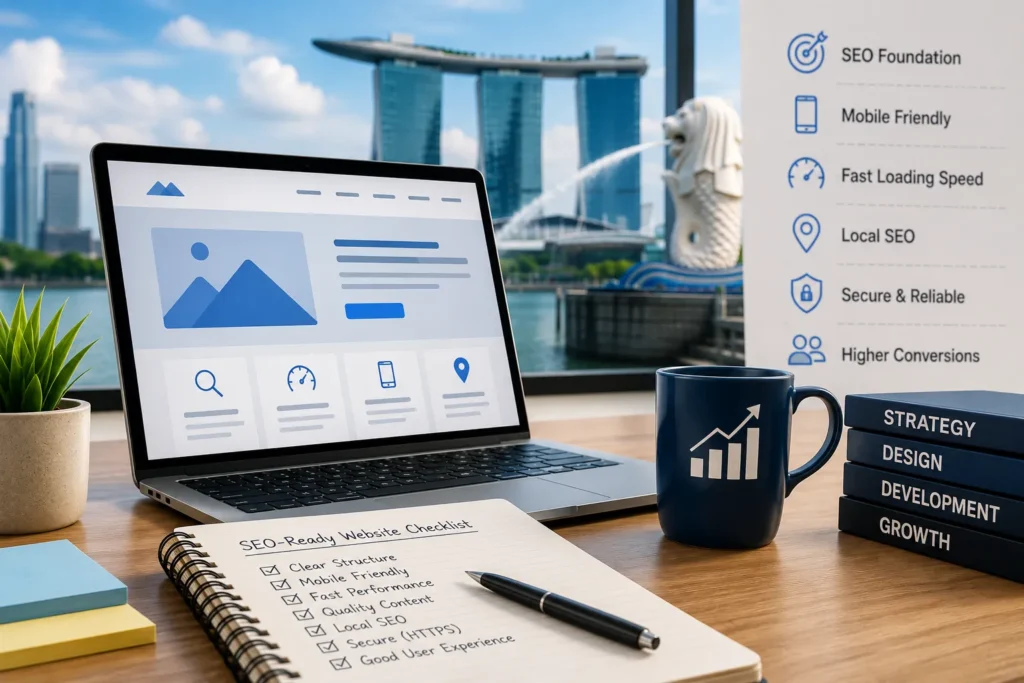
Here are the seven planning areas every SME should consider.
1. Start With Business Goals Before Design
Before choosing colours, layouts or animations, define what the website needs to achieve.
Does your SME need more enquiry form submissions? More calls? More online bookings? More product catalogue views? More trust before a sales conversation?
These goals affect the entire website structure.
A service business may need strong service pages, case studies and quote forms. A retail or product-based business may need product categories, filters, FAQs and clear purchase paths. A professional services firm may need credibility-focused pages, team profiles and educational articles.
Good website planning starts with business outcomes.
Your website should not simply exist online. It should support a business goal.
2. Build a Crawlable Site Structure
Search engines need to discover your pages before they can rank them. This is why your website structure matters.
A basic SME website should usually include:
- Homepage
- About page
- Main services page
- Individual service pages
- Works or portfolio page
- Blog or insights section
- Contact page
- Quote or project enquiry page
Each important service should have its own page where possible.
For example, a web development company should not hide all services inside one short paragraph. It is better to have dedicated pages for web development, SEO services, website maintenance and content support.
This helps both users and search engines understand what the business offers.
A crawlable website should also include an XML sitemap so search engines can discover important pages more efficiently. Google provides guidance on how to build and submit a sitemap, especially when a website has multiple service pages, blog posts or portfolio entries.
TechWeb’s own web development portfolio in Singapore shows how different website projects can be structured for different business needs, including e-commerce, learning portals, marine products, brand websites and SaaS platforms.
3. Plan Pages Around Search Intent
Search intent means the reason behind a search.
Someone searching “web development company in Singapore” may be looking for a provider. Someone searching “how to plan a website for SEO” may still be researching. Someone searching “website maintenance Singapore” may already know what service they need.
Each page should match a specific intent.
| Page Type | Search Intent | Page Goal |
|---|---|---|
| Homepage | Broad brand and service discovery | Explain who you are and what you do |
| Service page | Commercial research | Show the service, benefits and process |
| Blog article | Educational research | Answer questions and build trust |
| Works page | Proof and validation | Show experience and credibility |
| Contact page | Action | Make enquiry easy |
This is where your keyword strategy becomes important.
The main keyword for this article is SEO-ready website development Singapore. It should appear naturally in the title, introduction, at least one heading, body content and conclusion. However, the keyword should not be forced into every paragraph. Good SEO writing should still sound natural to the reader.
For broader educational content, businesses can also build an article hub like TechWeb’s web development and SEO insights section, which provides practical articles on web design, SEO and online growth.
4. Design for Mobile and Speed From the Start
Mobile performance should not be an afterthought.
For SMEs, this means:
- Text must be readable on mobile
- Buttons must be easy to tap
- Forms must be simple
- Navigation must be clear
- Images must be compressed
- Pages must load quickly
- Important content must appear on mobile too
A beautiful website that loads slowly can still lose visitors before they enquire. Speed, layout and mobile usability should be part of the development process from the beginning.
Speed should also be measured properly, not guessed. Google’s Core Web Vitals focus on real-world user experience, including loading performance, interactivity and visual stability. These are practical checks for SMEs because a slow or unstable website can cause visitors to leave before they take action.
When planning a new website, ask whether your developer will optimise images, reduce unnecessary scripts, test mobile layouts and review performance before launch.
5. Create Content Before Development Is Finished
Many website projects delay content until the end. This is a mistake.
Content affects page layout, SEO structure, user flow and calls to action. If content is rushed, the website may look complete but feel weak.
For an SEO-ready SME website, plan these content elements early:
- Homepage headline and positioning
- Service descriptions
- FAQs
- Case studies
- Testimonials
- Calls to action
- Meta titles
- Meta descriptions
- Image alt text
- Blog topics
The goal is not to write more words for the sake of SEO. The goal is to create useful content that helps customers understand your business and helps search engines understand each page.
Clear content also supports conversion. This is why content planning should sit together with design, SEO and development rather than being treated as a final copywriting task.
6. Build Trust Into the Website
For SMEs, trust is one of the biggest conversion factors.
A visitor may find your website through Google, but they still need reasons to choose you. Your website should show proof, not just promises.
Useful trust signals include:
- Real project examples
- Client logos
- Testimonials
- Before-and-after improvements
- Clear contact details
- Business location
- Team or founder information
- Transparent process
- Helpful FAQs
A strong About page also matters because it helps visitors understand who is behind the business, what the company stands for and why they should trust it. TechWeb’s About page positions the company around clarity, performance, growth and long-term relevance.
Trust should not be hidden at the bottom of the website. It should appear across the user journey.
7. Plan for Post-Launch Growth
A website launch is not the end of the project. It is the start of improvement.
After launch, SMEs should monitor:
- Which pages get organic traffic
- Which search queries bring visitors
- Which pages generate enquiries
- Where users drop off
- Which pages need stronger content
- Whether technical issues appear in Search Console
- Whether loading speed changes over time
This is why ongoing website maintenance is important. Your website needs to stay secure, updated, stable and easy to improve over time.
An SEO-ready website should be built so it can grow with your business.
Local SEO Should Not Be an Afterthought
For many Singapore SMEs, visibility is not only about ranking nationally. It is also about being found by people looking for nearby services, local providers or businesses they can contact quickly.
A complete Google Business Profile helps businesses appear across Google Search and Maps, with details such as business hours, photos, offers and contact information. This is especially useful for SMEs with a physical location or defined service area.
For local business websites, developers can also consider Local Business structured data to help search engines understand details such as business type, business hours, departments and other useful information.
Local SEO works best when your website, Google Business Profile and contact details are consistent. Your business name, address, phone number and service information should match across your main online platforms.
Accessibility Also Supports Better Website Planning
Accessibility should be part of good website planning.
The Web Content Accessibility Guidelines provide recognised recommendations for making web content more accessible. This includes users with visual, hearing, physical or cognitive needs.
For SMEs, accessibility does not need to feel complicated at the start. Practical steps include:
- Using readable font sizes
- Keeping enough contrast between text and background
- Adding alt text to important images
- Making buttons easy to identify
- Writing clear headings
- Avoiding confusing navigation
- Ensuring forms are easy to complete
A more accessible website is often a clearer website for everyone.
Suggested Website Structure for a Singapore SME
A practical SEO-ready structure may look like this:
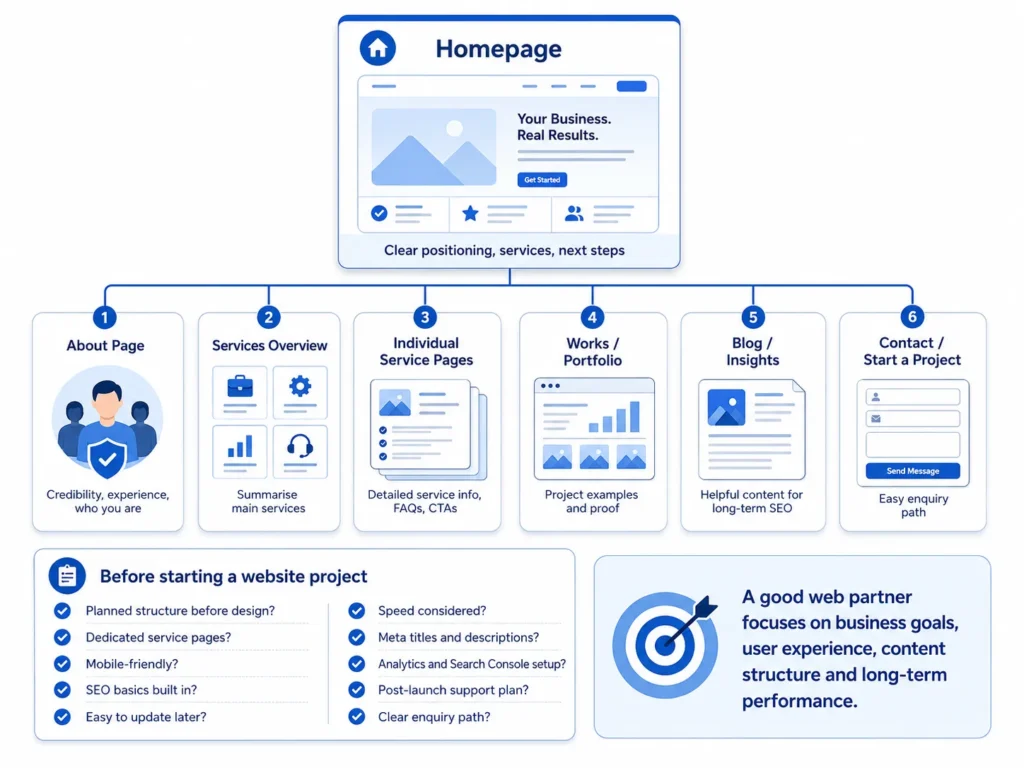
Homepage
The homepage should position the business clearly, explain the main services and guide users to the most important pages.
It should not try to say everything. Instead, it should act as a clear entry point that helps visitors understand who you serve, what you offer and where they should go next.
About Page
The About page should build trust by explaining who you are, who you serve and why your approach matters.
For SMEs, this page can be especially useful because many customers want to know whether the business is credible, reachable and experienced.
Services Overview Page
The services overview page should summarise your main services and link to individual service pages.
This makes it easier for users to compare your services and choose the most relevant one.
Individual Service Pages
Each important service should have its own page with detailed content, FAQs, benefits, process and calls to action.
For example, a business offering web development, SEO, content creation and website maintenance should consider giving each service its own dedicated page.
Works or Portfolio Page
A Works or Portfolio page helps visitors see proof of experience.
This is where you can show project examples, industries served, challenges solved and business outcomes supported.
TechWeb’s Works page is a useful example of how project experience can support trust and credibility.
Blog or Insights Section
A blog or insights section helps your business answer customer questions and build long-term search visibility.
This is especially useful for SMEs because educational articles can support both SEO and sales conversations. When customers ask the same questions repeatedly, those questions may become strong article topics.
Contact or Start a Project Page
Your contact page should make it easy for visitors to take action.
If you are planning a new website, you can start a website project with TechWeb and share your goals, services and project requirements. TechWeb’s Start a Project page is built around helping businesses plan a professional, SEO-ready online presence for clarity, performance and growth.
What to Ask Before Starting a Website Project
Before hiring a web development partner, SMEs should ask:
- Will the website structure be planned before design starts?
- Will each important service have its own page?
- Will the website be mobile-friendly?
- Will the pages be built with SEO basics in mind?
- Will the site be easy to update later?
- Will speed and performance be considered?
- Will meta titles and descriptions be prepared?
- Will Google Analytics and Google Search Console be set up?
- Will there be a post-launch support plan?
- Will there be a clear enquiry path for visitors?
These questions help you avoid building a website that looks good but performs poorly.
When comparing providers, look for a web development company in Singapore that understands business goals, user experience, content structure and long-term website performance.
A good development partner should not only ask what design style you like. They should also ask what your business needs the website to achieve.
Common Mistakes SMEs Make When Building a Website
Many website problems can be avoided with better planning. Here are some common mistakes SMEs should watch out for.
Mistake 1: Designing Before Planning the Structure
A website can look attractive but still be difficult to use.
Before design begins, the website structure should be mapped clearly. This includes the main pages, service pages, navigation menu, calls to action and internal linking approach.
Mistake 2: Using One Page for Too Many Services
Some SMEs place all their services on one page. This may seem simple, but it can limit SEO potential.
If each service targets a different type of customer or search intent, it should usually have its own page.
Mistake 3: Ignoring Mobile Users
A desktop design may look impressive, but many visitors will view the website on mobile devices.
If the mobile experience is slow, cramped or confusing, users may leave quickly.
Mistake 4: Treating Content as Decoration
Website content is not just filler text.
Good content explains your value, answers customer questions, supports SEO and guides users towards action. It should be planned with the same care as design and development.
Mistake 5: Launching Without Maintenance
A website needs care after launch.
Software updates, plugin updates, backups, security checks, bug fixes and content updates all matter. Without maintenance, even a well-built website can become slow, outdated or vulnerable over time.
How TechWeb Approaches SEO-Ready Website Development
TechWeb builds websites with a focus on clarity, credibility and growth.
The goal is not only to create a visually clean website, but to build a digital foundation that helps users understand your business and take the next step.
For SMEs, this means the website should be planned as a complete system. Design, structure, content, SEO and maintenance should work together instead of being treated as separate tasks.
A good SME website should help people find your business, understand your value and enquire with confidence.
This is the role of SEO-ready website development in Singapore: building a website that supports both search visibility and real business outcomes.
Final Thoughts
SEO-ready website development in Singapore is not about chasing rankings with shortcuts. It is about building a website properly from the start.
For SMEs, that means planning the structure, content, speed, mobile experience, internal links and conversion paths before the website goes live. When these foundations are strong, every future SEO effort becomes more effective.
A well-built website should not only look professional. It should be discoverable, understandable, trustworthy and ready to support long-term business growth.
If your business is planning a new website or improving an existing one, start a website project with TechWeb and build a clearer, faster and more effective online presence.
Frequently Asked Questions
What is SEO-ready website development?
SEO-ready website development means building a website with search visibility, user experience and conversion planning in mind from the beginning. It includes site structure, crawlability, mobile design, speed, content planning and on-page SEO basics.
Why is SEO-ready website development important for Singapore SMEs?
It helps SMEs build websites that can be found on search engines, explain their services clearly and guide visitors towards enquiries. This is especially important in Singapore’s competitive digital market, where customers often research businesses online before making contact.
Is SEO-ready website development the same as SEO services?
No. SEO-ready development creates the foundation. SEO services usually continue after launch through content updates, technical improvements, keyword tracking and authority building.
You can read TechWeb’s guide on SEO for small businesses in Singapore for a broader view of SEO strategy.
Should every service have its own page?
In most cases, yes. If a service is important to your business and customers search for it, it should usually have a dedicated page with clear content, FAQs and a call to action.
This helps users understand the service and helps search engines identify what the page is about.
How long does SEO take after launching a new website?
SEO is usually a long-term effort. A well-built website can give you a stronger foundation, but rankings and organic traffic normally improve through continued content, optimisation and monitoring.
The benefit of SEO-ready website development is that it reduces technical and structural problems that could slow down future SEO work.
What is the biggest mistake SMEs make when building a website?
The biggest mistake is treating SEO as something to add after launch.
It is better to plan SEO, structure and content before the website is designed and developed. This helps avoid weak pages, unclear navigation, poor keyword targeting and expensive fixes later.
Do SMEs need website maintenance after launch?
Yes. Website maintenance helps keep the site updated, secure, stable and performing properly. It also supports long-term improvement because websites need regular checks, technical updates and content refinement after launch.
How can I start planning an SEO-ready website?
Start by defining your business goals, target audience, key services, search terms, required pages and enquiry paths. Then work with a web development partner who can plan the website structure, content and technical foundation before design begins.







2 thoughts on “SEO-Ready Website Development in Singapore: Complete SME Planning Guide for 2026”
Pingback: 10 Small Business Website Conversion Tips That Turn Visitors Into Leads - Trailzi
Pingback: What Is SEO Digital Marketing and Why It Matters in 2026 - TechWeb