Introduction to AI in SEO
AI in SEO is no longer a futuristic concept. It is already reshaping how search engines rank content, how users find information, and how businesses compete online. Over the past decade, search engines have moved from simple keyword matching to sophisticated systems that understand context, intent and behavior. Artificial intelligence sits at the center of this shift.
At its core, AI in SEO refers to the use of machine learning, natural language processing, and predictive analytics to improve how content is discovered, evaluated, and ranked. Search engines now analyze patterns at a scale no human team could manage. Because of that, SEO has become less about tricks and more about relevance, quality and trust.
This shift matters now more than ever. Search behavior is changing. Voice search, conversational queries, and zero-click results are becoming normal. As a result, businesses that rely on outdated SEO tactics are falling behind. Meanwhile, organizations that understand how AI in SEO works are gaining a measurable advantage.
In this article, we will explore how AI in SEO is transforming content strategy, technical optimization, and trust signals. We will also look ahead to what this means for businesses that want sustainable search visibility.
What AI in SEO Really Means
AI in SEO refers to the use of machine learning, natural language processing and data analysis to improve search results and optimization strategies. Search engines no longer scan pages in a simple, linear way. Instead, they analyze patterns, context and meaning.
How Search Engines Use AI
Modern search engines use AI to:
Understand the intent behind search queries
Evaluate content quality and relevance
Detect spam and manipulation
Learn from user behavior over time
Algorithms like Google’s core systems rely on AI to continuously refine search results. This means SEO strategies must evolve alongside these systems.
Why AI in SEO Matters Today
Search behavior has changed. Users ask longer questions, use voice search and expect fast, accurate answers. AI helps search engines meet these expectations.
For businesses, AI in SEO means that shortcuts no longer work. Sustainable rankings come from quality, clarity, and credibility.
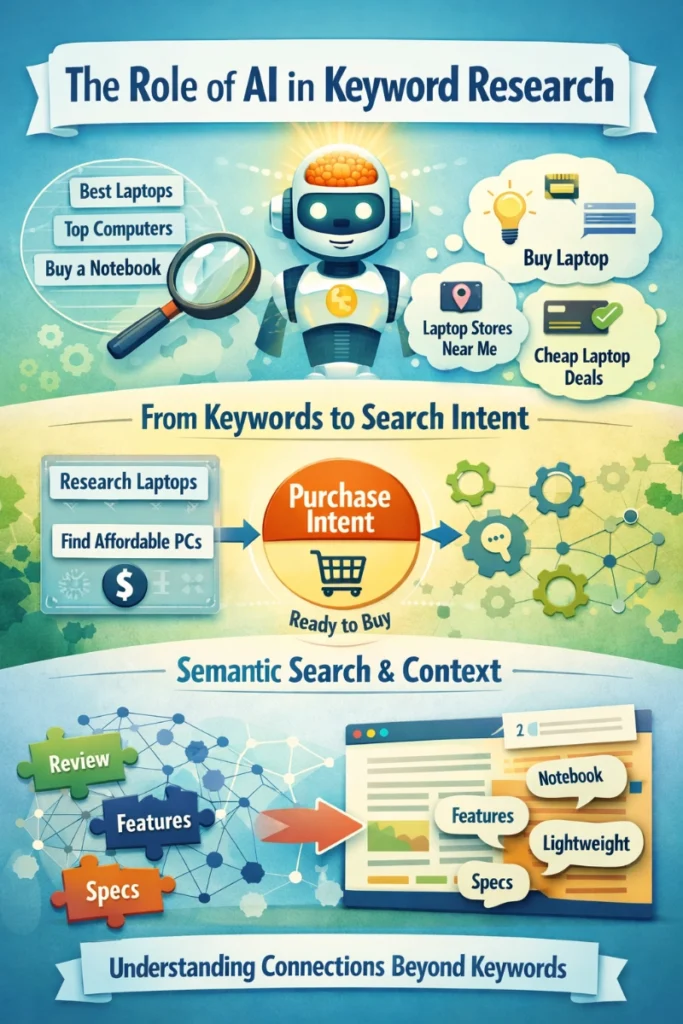
The Role of AI in Keyword Research
Keyword research has changed dramatically because of AI in SEO. Instead of focusing on exact phrases, modern SEO emphasizes intent and topics.
From Keywords to Search Intent
AI-powered tools analyze millions of searches to identify patterns. They group keywords by intent, not just wording. This helps content creators understand what users are really looking for.
For example, two different queries may share the same intent even if the words are different. AI helps uncover these connections.
Semantic Search and Context
Semantic search allows search engines to understand relationships between words and concepts. AI in SEO supports this by analyzing synonyms, related terms, and contextual signals.
This is why content that covers a topic thoroughly tends to rank better than content that simply repeats keywords.
AI in SEO Content Strategy
Content remains at the heart of SEO, but AI in SEO has raised the standards for what qualifies as “good” content.
Content Creation With AI Support
AI tools can assist with:
Research and topic discovery
Content outlines
Readability improvements
Optimization suggestions
However, AI works best as a support system. Human writers bring experience, judgment and creativity that machines cannot replace.
Human Expertise vs Automation
Search engines reward experience and expertise. Content that feels generic or automated often underperforms. Successful SEO teams combine AI efficiency with human insight.
This balance ensures content is both scalable and trustworthy.
Technical SEO Enhanced by AI
Technical SEO has become more complex, but AI in SEO makes it more manageable.
Crawling, Indexing, and Automation
AI helps identify:
Crawl errors
Broken links
Indexing issues
Page speed problems
Automated audits allow teams to fix issues quickly and maintain site health.
Predictive SEO and Forecasting
AI can analyze historical data to predict traffic trends and ranking changes. This allows SEO teams to act proactively instead of reacting after a drop occurs.
Predictive insights make SEO more strategic and less reactive.
AI in SEO and User Experience
User experience plays a major role in rankings, and AI in SEO connects UX directly to performance.
Engagement Signals and Behavior Analysis
AI evaluates:
Time on page
Click-through rates
Navigation patterns
If users find content helpful, rankings improve. If they struggle, performance declines. AI helps identify what users like and what needs improvement.
AI, E-E-A-T and Trust
Trust is central to modern SEO, and AI in SEO reinforces this focus.
Building Authority With AI Insights
AI systems analyze:
Author credibility
Brand mentions
Backlink quality
Content consistency
Trust sits at the heart of modern SEO. As search engines become more intelligent, they are placing greater emphasis on who creates content, why it exists, and how reliable it is. This is where Google’s E-E-A-T framework – Experience, Expertise, Authoritativeness, and Trustworthiness – becomes critical. AI in SEO reinforces this focus by helping search engines evaluate trust signals at scale. Clear authorship, accurate information and reputable sources strengthen trust signals. This aligns closely with Google’s E-E-A-T framework.
Ethical Use of AI in SEO
Ethics matter in SEO. While AI offers efficiency, misuse can harm credibility.
Ethical AI in SEO means:
Avoiding mass-produced low-quality content
Ensuring accuracy and originality
Prioritizing user value
Search engines reward helpful content, not automation for its own sake. Google’s guidance on this can be found here:
https://developers.google.com/search/docs/fundamentals/creating-helpful-content
The Future of AI in SEO
AI in SEO will continue to evolve. Search results will become more personalized, conversational and predictive.
Businesses should prepare by:
Investing in expertise and quality
Building topical authority
Using AI responsibly
Focusing on long-term value
Those who adapt early will benefit the most.
Frequently Asked Questions (FAQs)
1. What is AI in SEO, and why is it important?
AI in SEO refers to the use of artificial intelligence to analyze search behavior, content quality and ranking signals. It is important because modern search engines rely on AI to understand intent, context, and user satisfaction. Without considering AI in SEO, optimization strategies quickly become outdated.
2. How does AI influence Google’s ranking algorithms?
AI helps Google interpret search queries, evaluate content relevance and learn from user behavior. It allows algorithms to:
Understand natural language
Identify search intent
Detect low-quality or manipulative content
Adjust rankings based on engagement signals
This makes rankings more accurate and user-focused.
3. What is Google E-E-A-T, and how does it relate to AI in SEO?
E-E-A-T stands for Experience, Expertise, Authoritativeness, and Trustworthiness. AI systems help Google evaluate these signals by analyzing authorship, content consistency, backlinks, brand mentions, and user behavior. AI does not replace E-E-A-T—it measures it at scale.
4. Can AI-generated content rank well in search results?
Yes, AI-generated content can rank well if it is accurate, original, helpful and reviewed by humans. Content that lacks experience, expertise or trust signals may struggle. Google focuses on content quality, not how the content was created.
5. How does AI improve keyword research compared to traditional methods?
Traditional keyword research focuses on exact phrases. AI-driven keyword research focuses on:
Search intent
Topic relationships
Semantic meaning
User behavior patterns
This leads to content that answers real questions instead of just matching keywords.
6. Does AI replace the need for SEO professionals?
No. AI supports SEO professionals by speeding up research, analysis, and monitoring. However, human expertise is still required for strategy, creativity, ethical judgment, and brand voice. The strongest results come from collaboration between humans and AI.
7. How can small businesses use AI in SEO effectively?
Small businesses can use AI tools to:
Identify content opportunities
Optimize existing pages
Monitor technical SEO issues
Understand user intent
Many AI-powered SEO tools are affordable and accessible, making them suitable for smaller teams.
8. How does AI help measure trust and authority?
AI analyzes signals such as:
Author credibility and transparency
Brand mentions across trusted sites
Backlink quality and relevance
Content accuracy and consistency
These signals help search engines determine whether a website is trustworthy and authoritative.
9. What are the risks of using AI in SEO incorrectly?
Common risks include:
Publishing unreviewed AI-generated content
Over-optimizing without user value
Ignoring brand voice and experience
Chasing automation instead of strategy
These mistakes can harm trust and long-term rankings.
10. How does AI affect user experience in SEO?
AI evaluates how users interact with content, including time on page, navigation, and engagement. Content that meets user expectations performs better. Poor user experience signals can negatively impact rankings, even if keywords are present.
11. Will AI make SEO fully automated in the future?
SEO will become more automated, but it will not become fully automatic. Human insight will always be needed for strategic decisions, ethical use, storytelling, and brand differentiation.
12. What should businesses focus on to succeed with AI in SEO long term?
To succeed long term, businesses should:
Invest in expertise and credible authors
Create helpful, in-depth content
Use AI responsibly and ethically
Maintain transparency and trust
Focus on user value over shortcuts
AI rewards quality, not manipulation.
AI in SEO is no longer optional—it is shaping how search engines understand content, measure trust, and deliver meaningful results to users. As artificial intelligence continues to evolve, SEO is becoming less about chasing algorithms and more about creating genuinely helpful, credible, and well-structured content.
The most successful SEO strategies today balance AI-driven insights with human expertise. AI helps uncover intent, patterns, and opportunities, while people provide experience, judgment, and authenticity. Together, they create content that search engines trust and users value.
Google’s focus on E-E-A-T reinforces this direction. Clear authorship, accurate information, consistent messaging, and ethical use of AI are no longer “nice to have”—they are essential for long-term visibility and stability in search rankings.
For businesses that want to stay ahead, working with experienced professionals makes a real difference. TechWeb helps organizations navigate AI-driven SEO by combining technical expertise, content strategy, and a deep understanding of search engine evolution. If you’re looking to build a future-ready SEO strategy powered by AI and trust, you can explore their offerings here: https://techweb.sg/our-services/
In the end, AI in SEO is not about outsmarting search engines. It is about aligning with their purpose—delivering the most relevant, trustworthy answers to real people. Businesses that embrace this mindset will be well-positioned to grow, adapt, and succeed as search continues to evolve.